Hi Selamawit!
This image has important information that's cropped out. Can you provide an image that contains the whole thing?
-Ben


Replied on Lesson: SN1 Reactions
Replied on Lesson: Reactions of Epoxides
Hi Erika!
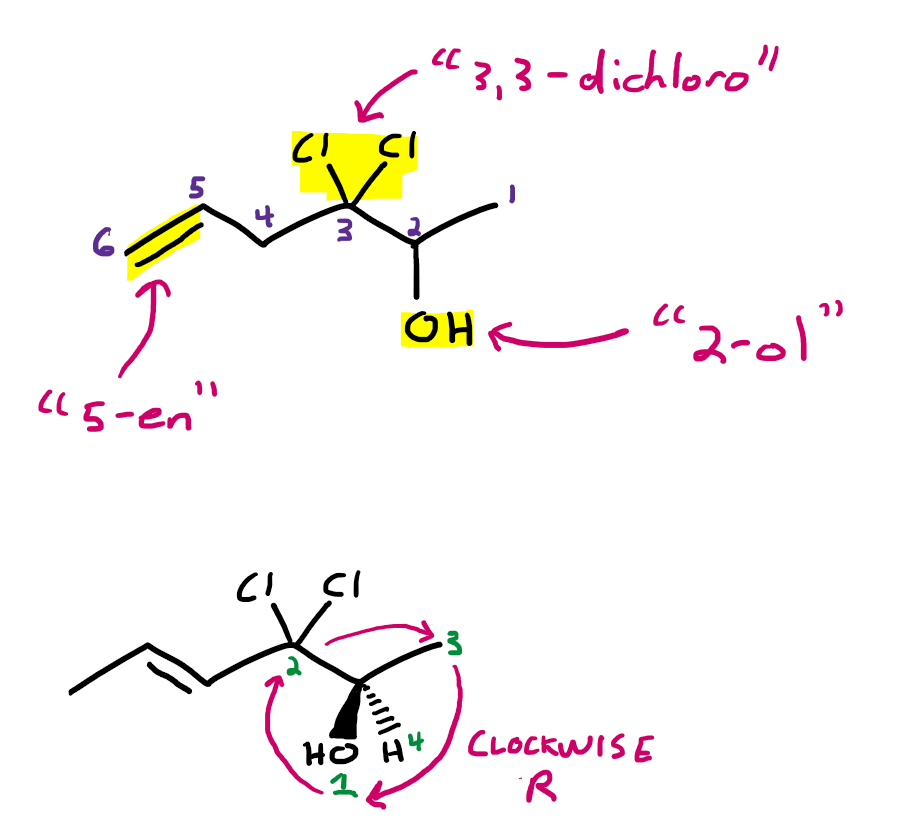
See the attached image.
The "hex" prefix means we have six carbons in the parent chain.
The "3,3-dichloro" means we have two chlorine atoms bonded to carbon 3 on the six-atom chain.
The "5-en" means we have a carbon-carbon double bound between carbons 5 and 6.
The "2-ol" means we have a hydroxyl group at carbon 2.
The "(R)" means that carbon 2, a chiral center, has an R configuration. We have lessons on stereochemistry that go into detail about what this means. First we assign Cahn-Ingold-Prelog priorities to each group bonded to the chiral center. These are shown in green. Next, we imagine the lowest-priority group (the H) in the back. If the group 1 > group 2 > group 3 sequence follows the CLOCKWISE direction, then it's R. If the group 1 > group 2 > group 3 sequence follows the COUNTERCLOCKWISE direction, then it's S. In this case, since it's CLOCKWISE, it's R.
-Ben
Replied on Lesson: SN1 Reactions

Hi Nicole!
See the attached image.There are two SN2 reactions back-to-back, each of which takes place with inversion.
For the first reaction, with PBr3, we can represent the inversion by switching the places of the hydrogen and methyl group on carbon 1 (methyl group goes from wedged to dashed).
For the second reaction, with KCN, we can represent the inversion, again, by switching the places of the hydrogen and methyl group on carbon 1 (methyl group goes from dashed back to wedged).
-Ben
Replied on Lesson: IR Spectroscopy
Replied on Lesson: Mass Spectrometry
Replied on Lesson: Reactions of Epoxides
Hi Mona!
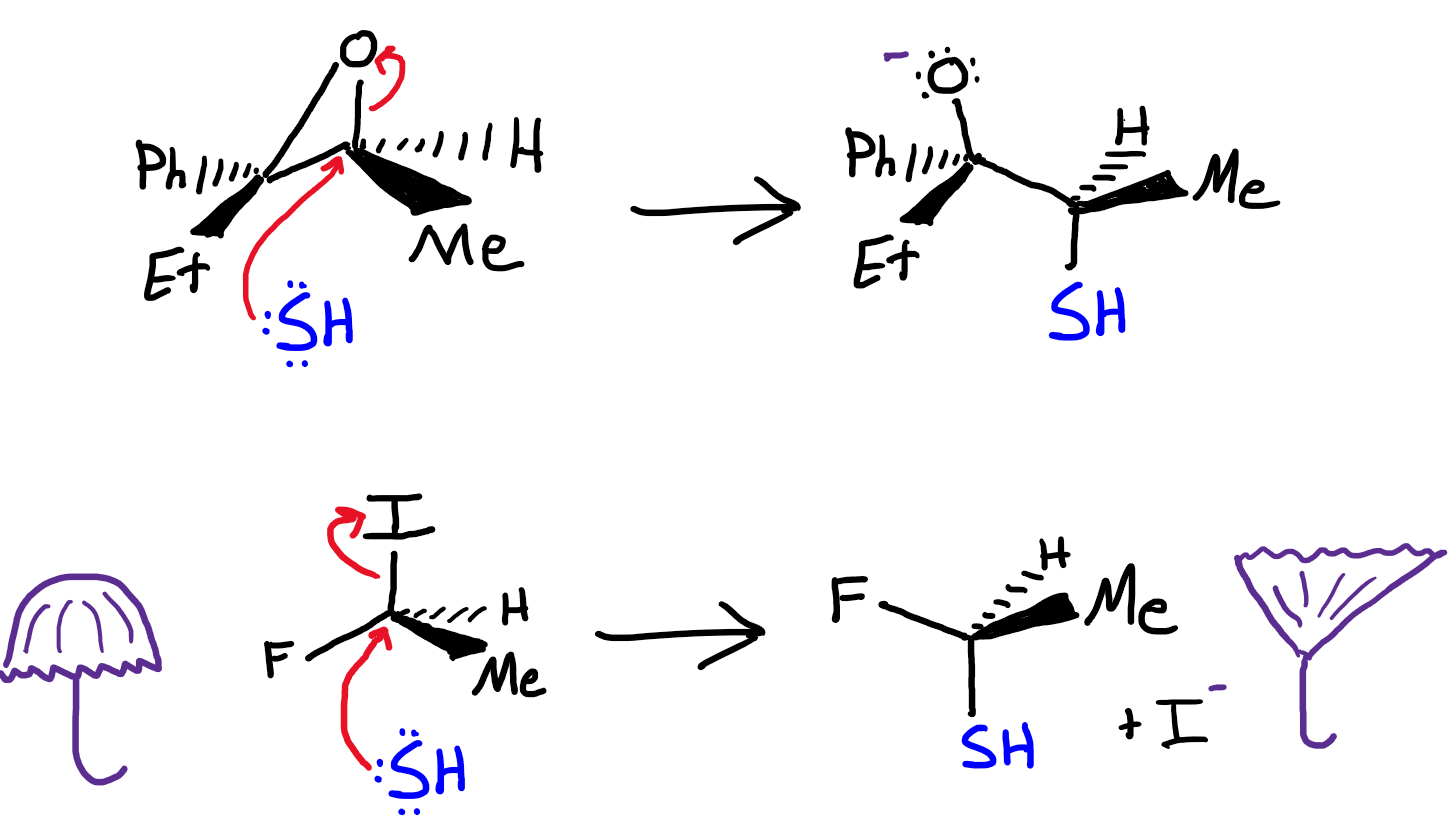
If you're asking if the methyl group should be in front of the plane of the screen (wedged) and the hydrogen atom should be behind the plane of the screen (dashed), the answer is no.
See the attached image. I've drawn it a little bit differently to better show the nature of SN2 substitution. Imagine the bonds to the hydrogen atom, the methyl group, and the CPhEtO- carbon form an umbrella-type shape. Upon SN2 substitution, the umbrella turns inside out, and the three bonds that were pointing downward are now pointing upward, but the wedges and dashed lines haven't changed.
This can be difficult to see if the molecule is a ring. I've provided another example, SN2 substitution of 1-fluoro-1-iodoethane to help get the point across.
Replied on Lesson: Reactions of Ethers
Replied on Lesson: Naming Alkynes and Alkyne Containing Compounds
05 Nov 14:41
Hi Briana!
It's based on an arbitrary list of functional group priorities set by the International Union of Pure and Applied Chemistry (IUPAC).
When there's a tie between a double bond and a triple bond for the purpose of determining the lowest locant, the double bond will always take priority.
-Ben