Ben - Subject Expert

Image for the badge Day One Done.
Day One Done earned for a 1-day streak!

Hi Katheryn,

Yes, I should have specified where the E is located.  In this particular molecule, there's only one double bond, so it's unambiguous that the E configuration applies to the double bond between carbons 3 and 4, but if we're strictly following the rules of IUPAC nomenclature, we give E or Z configurations a locant in the name every time no matter what.

Thank you for catching that!

-Ben

16 Sep 04:12

For the 22:30 example, yes, you can compare the acidity of different hydrogens within the same molecule by looking at hybridization.  In trans-2-butene (the molecule on the right), there are two different types of carbon and two different types of hydrogen.  The internal carbons are sp2 hybridized, and the terminal carbons are sp3 hybridized.  Since acidity increases with increasing s character, we would predict that the hydrogens bonded to the internal carbons are more acidic than the hydrogens bonded to the terminal carbons.

-Ben
16 Sep 04:09

Hi Stephanie,

Electronegativity applies to individual atoms within molecules, not to entire molecules themselves.  However, you're correct in thinking that more oxygen atoms bonded to the atom bearing the -OH increases acidity.  For instance, HClO4 is stronger than HClO3, which is stronger than HClO2, which is stronger than HClO.  The reason is that oxygen atoms, being highly electronegative, withdraw electron density away from the O-H bond, weakening and polarizing it, allowing the O-H hydrogen to be donated with greater ease.  This is the consequence of inductive effects that is discussed at 18:37.   It's not so much about the whole molecule as it is about the O-H bond itself.  In the example at 18:20, the conjugate base of one of the acids is resonance-stabilized, and the conjugate base of the other acid is not resonance-stabilized, and resonance generally has a greater influence on acid strength than induction.

Continued in reply  

2025-09-13-answer.png

Hi Joelle,

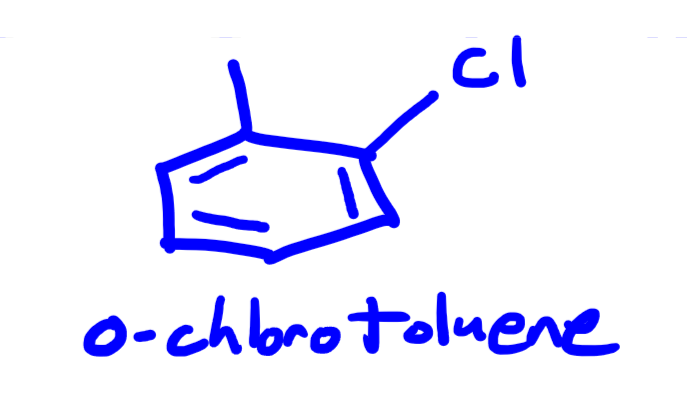
No, o-chlorotoluene would not be correct. The name must show that there are two chlorine atoms bonded to the ring, so we show where there are (3,4) and how many there are (dichloro).

The name "o-chlorotoluene" only accounts for one chlorine atom.

-Ben

13 Sep 19:13

Hi Stephanie,

If a carbon atom was bonded to four hydrogens and a carbon atom, it would have a total of 10 electrons in its valence shell--two electrons for each of the five bonds--which is not possible.  Since carbon is a period 2 element, its valence shell can only hold eight electrons.  There are other elements further down in the periodic table such as phosphorus and sulfur, that can have an expanded octet, but it doesn't work for carbon.

-Ben

13 Sep 18:55

Hi Paola,

In the structure on the left, the carbon atom has the following:  a double bond to the nitrogen, a single bond to a hydrogen, and a single bond to a carbon.  The hydrogen is understood, since no charge is shown and carbon needs a total of four bonds to be neutral.

If the pi electrons of the C=N bond move to the nitrogen atom, now the carbon has three bonds--a single bond to the nitrogen, and the same single bonds to hydrogen and carbon it had previously.  Since the carbon now has three bonds (three singles) instead of four bonds (a double and two singles), the carbon is no longer neutral.  Since the carbon has one fewer bond than is necessary to be neutral, it carries a positive charge, which needs to be shown.

If the positive charge wasn't shown, the reader would assume that the carbon has two hydrogens, which is false.  What Melissa was saying is that we need to show the positive charge to avoid confusion.

-Ben

2025-09-10-answer.png

Hi Paola,

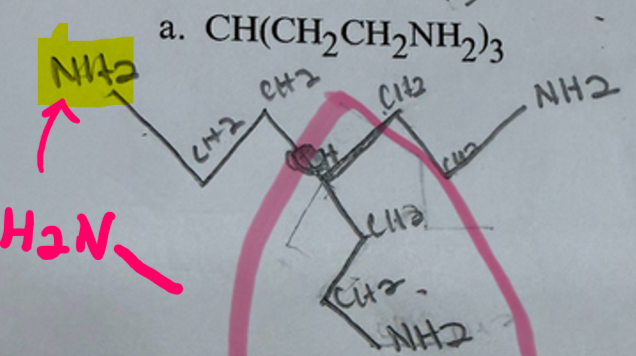
Yes, your structure is correct.  Both yours and Melissa's structure show a central carbon bonded to a hydrogen and three aminoethyl groups.  The one thing I would suggest is on the upper left end of the molecule, it's good to show clearly that the nitrogen is the atom that's bonded to the carbon.  We can do this by displaying the amino group as "H2N" rather than "NH2" (see the attached image).

-Ben

At 03:41, the instructions are similar.  With each pair of compounds, we're looking for the less stable or more reactive one.  That's the one that, when allowed to undergo hydration and reach equilibrium, will have the higher concentration of hydrate in the mixture.

Hi Allen,

In an equilibrium of two compounds, the compound that is favored, meaning the compound that is present at a higher concentration than the other, is the more stable and less reactive compound.  Apologies, the second bullet point at the slide that starts on 00:20 is incorrect.

If we're comparing two carbonyl compounds in terms of which of the two would have the higher amount of hydrate at equilibrium, what we're looking for is the less stable and more reactive compound.

In the example at 01:11, we're ranking them from least amount of hydrate present to most amount of hydrate present.  In other words, we're ranking them from most stable to least stable.  Another way of saying it would be that we're ranking them from least reactive to most reactive.  The third choice, which is an aldehyde with an electron-withdrawing group that destabilizes the carbonyl group, is the least stable and most reactive of them all, giving it the number 4 when ranked this way.* Continued in reply *

2025-09-08-answer.png

Hi Paola,

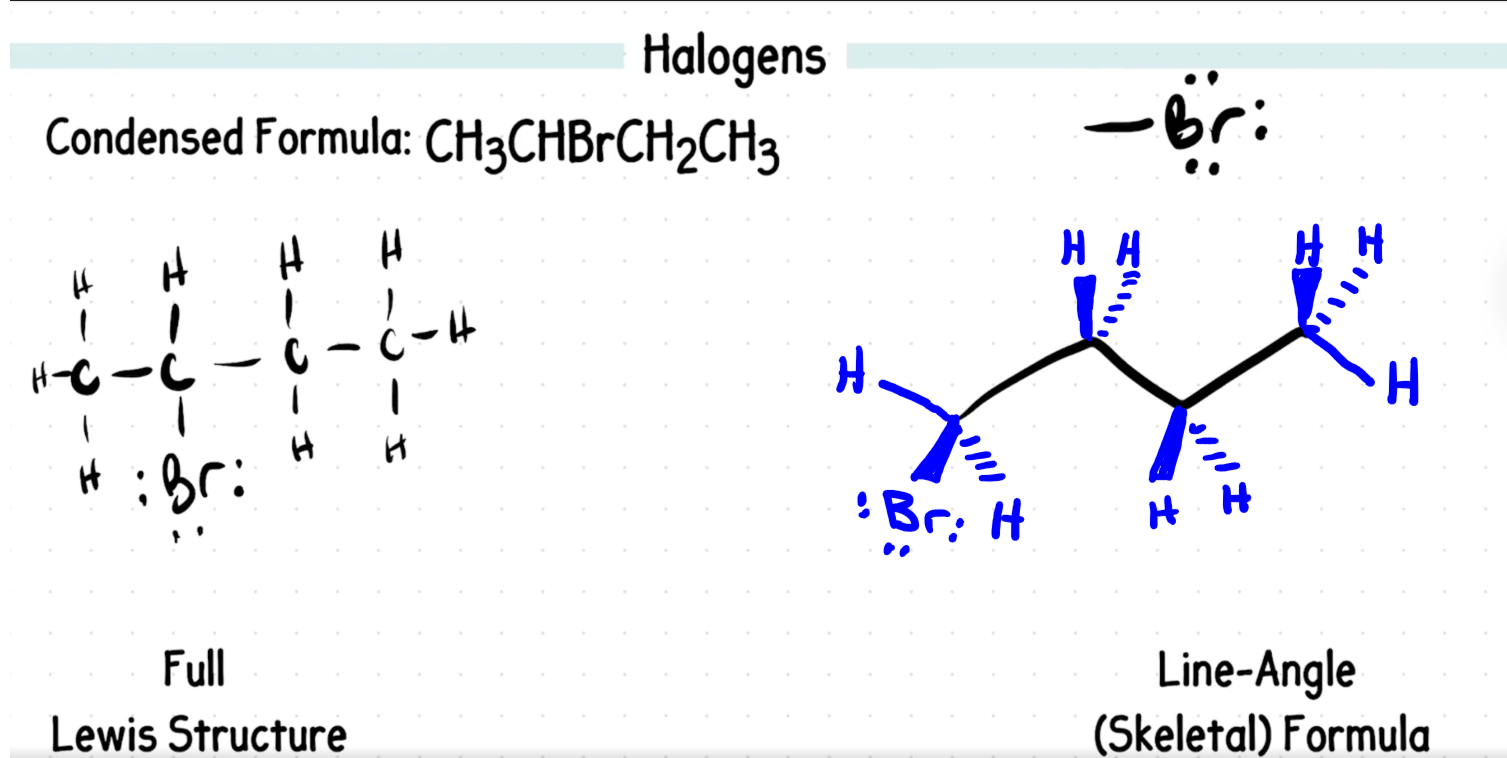
At timestamp 37:39, the objective is to draw a full Lewis structure and a Skeletal formula from a condensed formula.  At this point of the video, the three-dimensional aspect of it hasn't been discussed in detail yet.

Applying VSEPR theory to the formula to draw more three-dimensionally accurate structures is introduced at timestamp 38:19

At timestamp 52:07, we take it a step further and draw a three-dimensionally accurate Lewis structure of a molecule using the principles of VSEPR theory.

If we wanted to apply VSEPR theory to the molecule at timestamp 37:39, we'd see that every carbon, being bonded to four other atoms, has a tetrahedral molecular geometry with a bond angle of approximately 109.5°.  We can draw the parent chain (the four-carbon chain) in the plane of the page, and use wedges and dashed lines to fill in the hydrogens and the bromine in a way that completes the tetrahedral geometry around all carbon atoms (see the attached image).

-Ben