Ben - Subject Expert

Image for the badge Day One Done.
Day One Done earned for a 1-day streak!
2025-02-18-answer.png

Hi Mahi,

I'm not sure what you mean by "sp3 peak", but the carbonyl group of an ester typically absorbs at 1735 cm-1 for saturated esters and 1720 cm-1 for aromatic esters, which is somewhat higher than the 1715 cm-1 absorption we typically see for saturated ketones.

Additionally, esters have two C-O bonds that appear as strong peaks in the 1300 - 1000 cm-1 range. For reference, I've attached the IR spectrum of ethyl acetate, a common ester.

While it may be possible that it's an ester from the IR spectrum alone, the mass spec and NMR confirm otherwise.

-Ben

2025-02-12-answer2.png

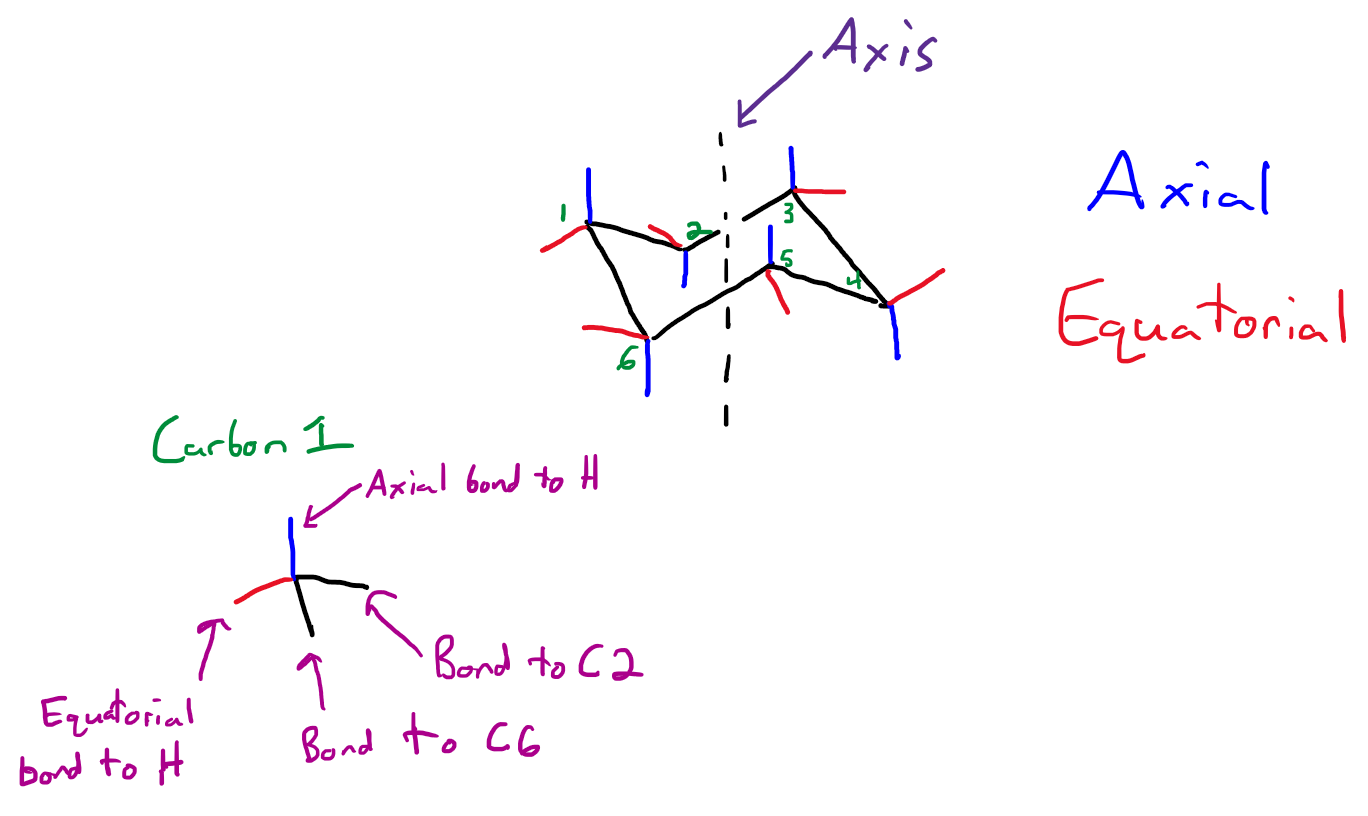
Hi Michelle.See the attached image.

Axial means the bond points parallel to the ring's axis.

Equatorial means the bond lies roughly in the plane of the ring, forming an "equator".

In a cyclohexane chair, each carbon atom has tetrahedral geometry with a bond angle of ~109.5°.  In order to keep this geometry, each carbon has two bonds to another carbon atom, an axial bond to a hydrogen atom, and an equatorial bond to a hydrogen atom.

-Ben
2025-02-12-answer.png

Hi Pam,

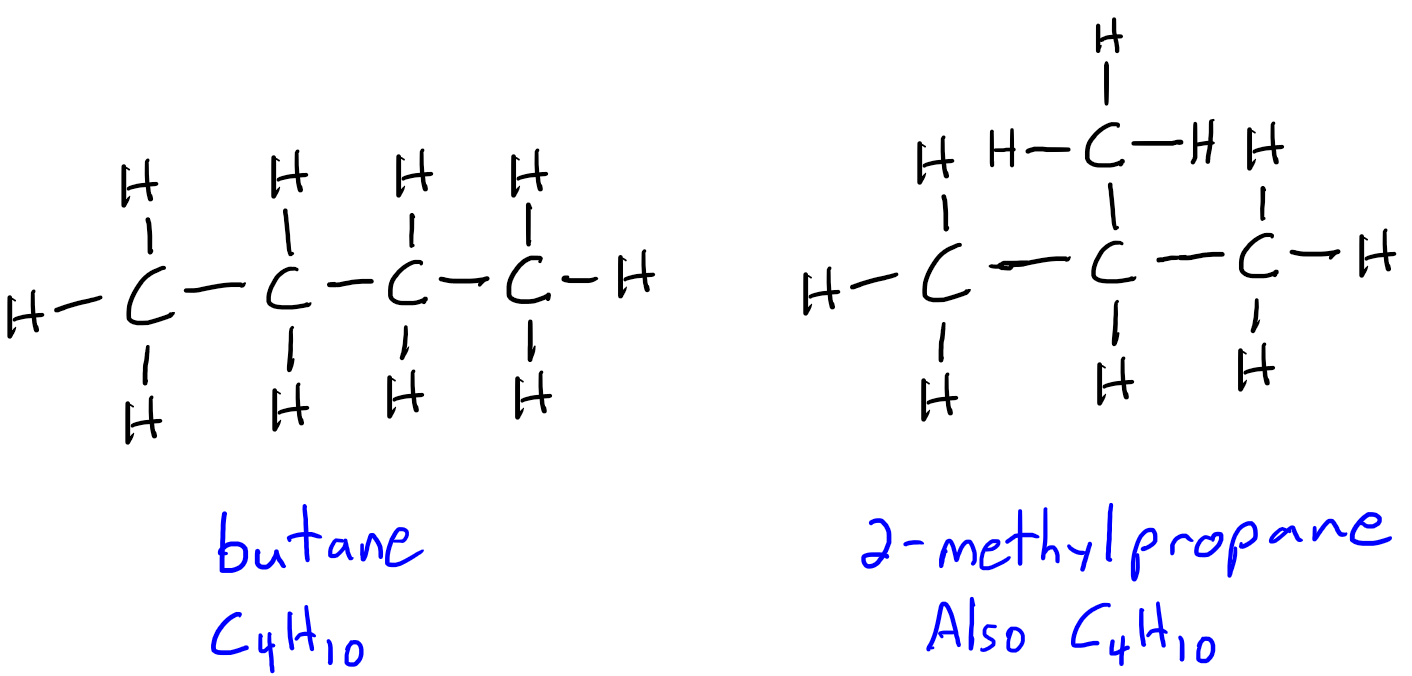
The goal of the exercise is to draw all constitutional isomers--all possible arrangements of atoms and bonds that have the formula C4H10.  So we're asking ourselves "what are all the different molecules we can draw that have four carbons and ten hydrogens (that don't violate Lewis structure rules)?"

We start with the simplest example--a straight chain of four carbon atoms.  The two carbons on the ends each have 3 hydrogens, and the interior carbons each have 2 hydrogens, for a total of 10.

Is that the only possibility?  No, because instead of a four-carbon chain, we could draw a three-carbon chain with a one-carbon branch in the middle. The two carbons on each end of the three-carbon chain each have 3 hydrogens.  The carbon in the middle of the three-carbon chain has one hydrogen.  And the carbon of the branch has 3 hydrogens, for a total of 10.

So we have two constitutional isomers of C4H10, which are butane and 1-methylpropane.

-Ben

Hi Dejaie,

The IUPAC rule for naming alkyl halides states that we number the carbons of the parent chain starting at the end closer to the first substituent, whether it's alkyl or halo.  By this rule alone, the parent chain could be numbered starting from the isopropyl-, the bromo-, or the cyclopropyl-.

However, to make things unambiguous, the IUPAC has another rule, which is that if the parent chain can be numbered from multiple locations and still satisfy the rule above, then alphabetical order takes precedence.  So we number from bromo-, to cyclopropyl-, to isopropyl-.

-Ben

Hi Michelle,

Yes, it's the same thing.

-Ben

09 Feb 19:08

2025-02-09-answer3png.png

Hi Michelle,

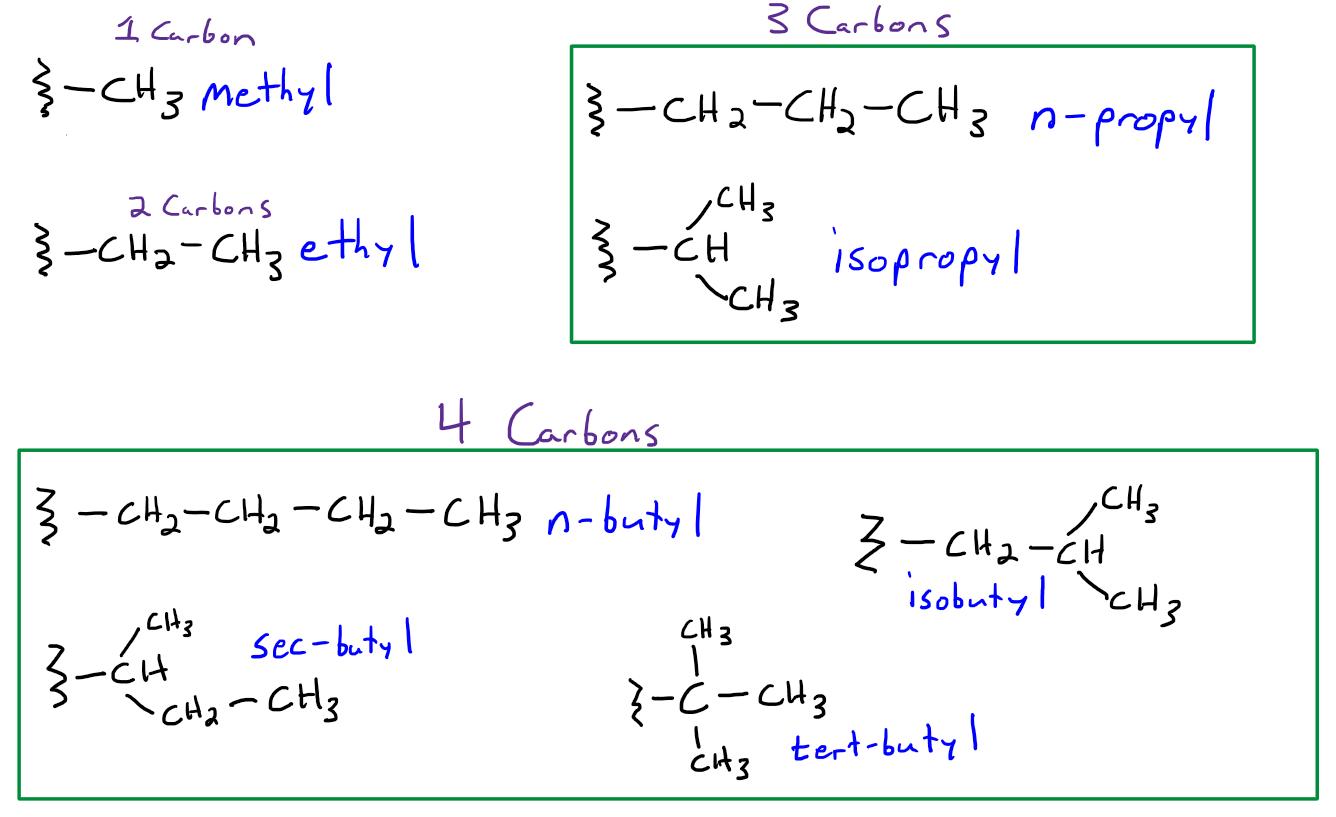
Alkyl groups are named according to the number of carbons they contain using the following prefixes:

• 1 carbon:  meth-

• 2 carbons:  eth-

• 3 carbons:  prop-

• 4 carbons:  but-   ...and so on

For methyl (1 carbon) and ethyl (2 carbon) groups, there's only one way they can be attached to a larger chain.

For propyl groups (3 carbons), there are two possibilities:

• The larger chain is attached to one of the ends of the three-carbon chain. This is the n-propyl group.  The "n" stands for "normal", which means a straight three-carbon chain with no branches.  Oftentimes the "n" will be omitted and it will be referred to simply as a propyl group.

• The larger chain is attached to the middle carbon of the three-carbon chain.  This is the isopropyl group.

For butyl groups (4 carbons), there are four possibilities--n-butyl, sec-butyl, tert-butyl, and isobutyl.  Notice that all of these groups contain four carbons, but those four carbons differ in their connectivity.

-Ben

2025-02-09-answer2png.png

Hi michelle,

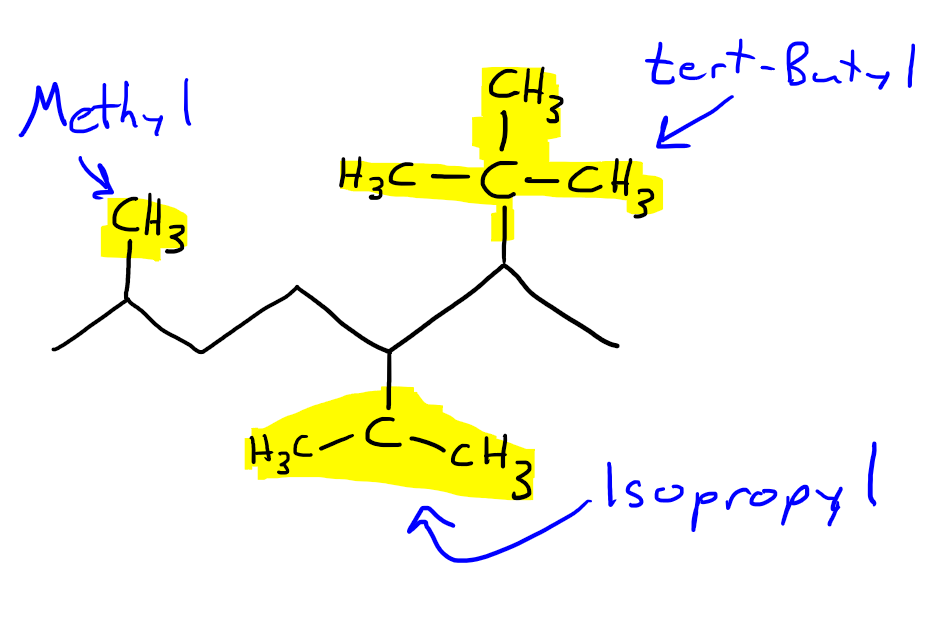
An alkyl group is simply an alkane that's missing a hydrogen, bonded to a larger chain of carbon atoms.  The simplest alkyl group is a methyl group (-CH3). Other examples of alkyl groups include ethyl groups (-CH2CH3), isopropyl groups (-C(CH3)2) and tert-butyl groups (-C(CH3)3).

As for the primary/secondary/tertiary concept, see the answer I gave to your other question for an explanation.

-Ben

2025-02-09-answer.png

Hi Michelle,Primary, secondary and tertiary just refer to the number of carbons attached to the carbon or functional group of interest.

• A primary (1°) carbon is bonded to one other carbon.

• A secondary (2°) is bonded to two other carbons.

• A tertiary (3°) is bonded to three other carbons.

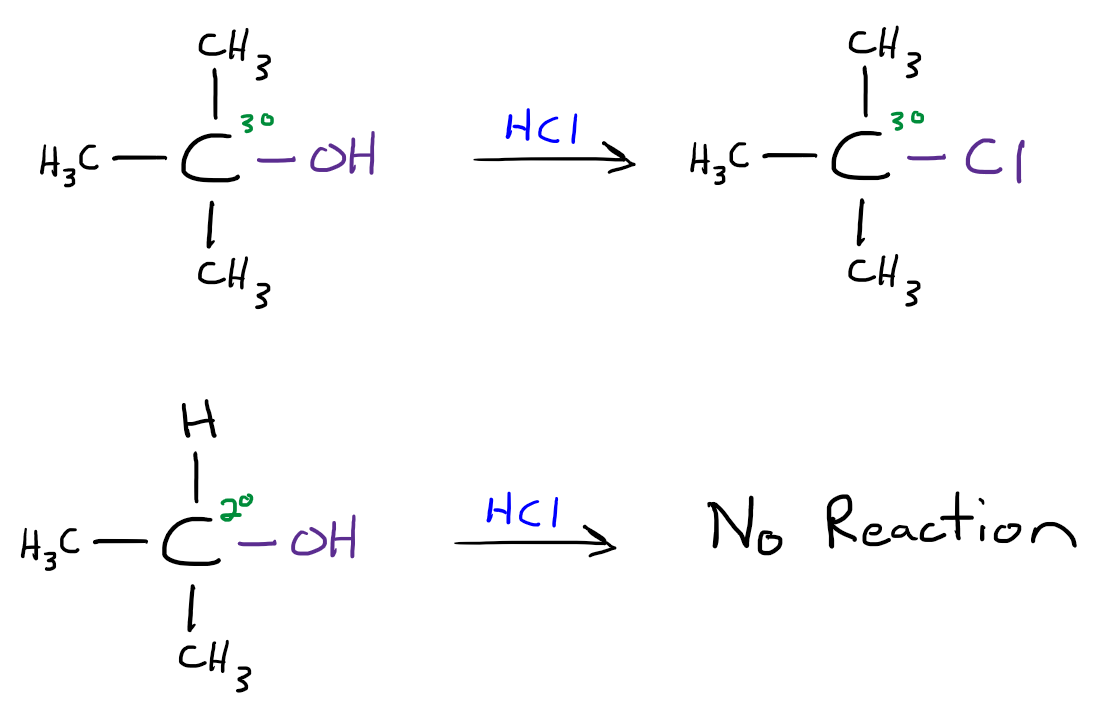
Whether a carbon is primary, secondary, or tertiary has a dramatic effect upon its reactivity.  For instance, tert-butanol is a tertiary alcohol.  The -OH group is bonded to a carbon that is bonded to three other carbons.  When tert-butanol is treated with HCl, it's converted into tert-butyl chloride.  If we tried the same thing with isopropanol, a secondary alcohol, the reaction won't work.

A good example of how the primary/secondary/tertiary concept affects reactivity can be found in Melissa's video on hydrohalogenation of alkenes (link in reply).  Specifically, at the timestamp 01:46 of that video, the relative stability of primary, secondary, and tertiary carbocations is discussed.

-Ben

Hi Melissa!

Yes, aldol reactions are reversible for both aldehydes and ketones.

Yes, a crossed aldol reaction is also reversible.

The position of the equilibrium depends on the conditions of the reaction and the structure of the substrate.  With aldehydes with no alpha substituent (RCH2CHO), the equilibrium favors the condensation product. With aldehydes that are disubstituted (R2CHCHO), and most ketones, the equilibrium favors the reactants.

-Ben