Ben - Subject Expert

Image for the badge Day One Done.
Day One Done earned for a 1-day streak!

Hi Paola,

I'm a little confused.  Could you show me the original problem you're trying to solve?  What is the structure you're starting from and the question itself (i.e. draw a Newman projection viewed along the C2 > C3 bond)?

-Ben

25 Sep 04:22

2025-09-25-answer2.png

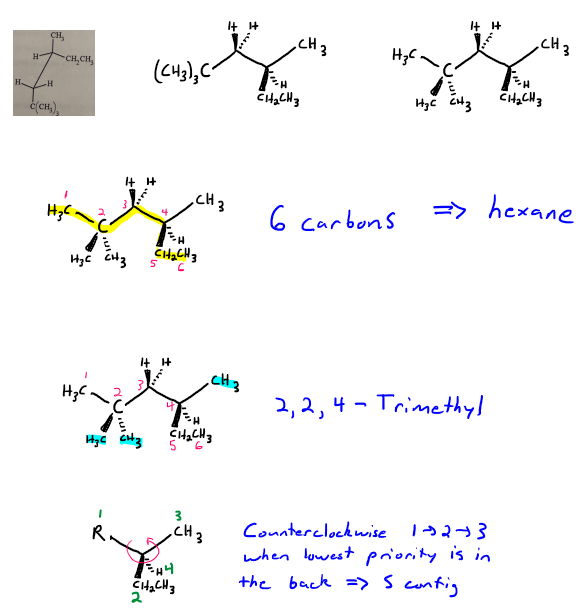
For this one, we can turn the molecule sideways, keeping track of where are substituents are to convert to a structure that uses wedged and dashed lines.  This way, we can see the atoms a little bit better.

The parent chain is six carbons long, so we have have some sort of hexane.  Numbering from the left gives us our first branch point.

There are three methyl groups-two on carbon 2, and one on carbon 4, so it's 2,2,4-trimethyl.

Carbon 4 is a chiral center.  Cahn-Ingold-Prelog priorities are as follows: carbon 3 is priority 1, the ethyl group is priority 2, the methyl group is priority 3, and the hydrogen is priority 4.  With the lowest priority group in the back, the 1 > 2 > 3 sequence follows the counterclockwise direction, so carbon 4 has the S configuration.

So putting it all together, it's (4S)-2,2,4-trimethylhexane.

-Ben
25 Sep 04:01

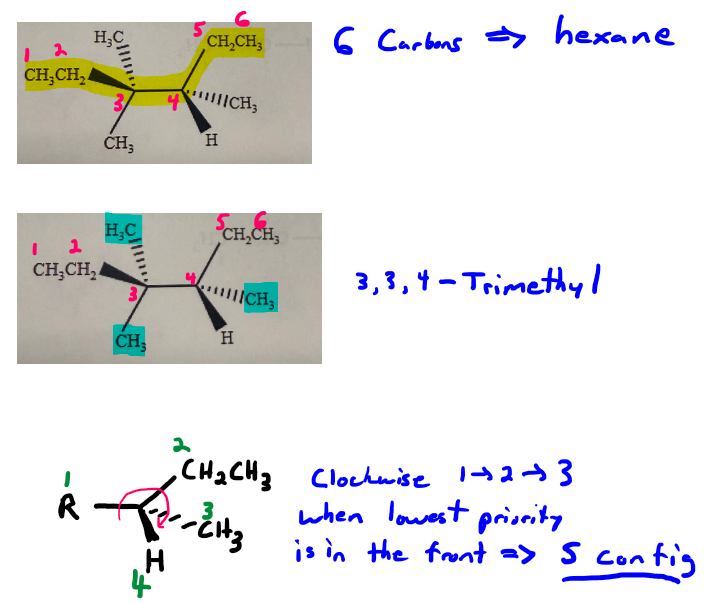
Now we apply stereochemistry.  Carbon 4 is a chiral center.  If we assign Cahn-Ingold-Prelog priorities to the four atoms or groups to which carbon, we'll get the following:  Carbon 3 is priority 1, the ethyl group is priority 2, the methyl group is priority 3, and the hydrogen is priority 4.  With the lowest priority group in the front, the priority 1 > 2 > 3 sequence follows the clockwise direction, which means our chiral center has the S configuration.  And we need to identify in the name which carbon it is, so we'll put (4S) in the name.

So putting it all together is (4S)-3,3,4-trimethylhexane.

-Ben

25 Sep 03:54

2025-09-25-answer.png

Hi Paola,

So we don't need to use VSEPR theory and bond angles to name it, but we do need to understand the rules of naming alkanes and how to assign R or S configurations to chiral centers.

We start with naming the parent chain and number from the end closer to the first branch point.  The parent chain will be the longest, which we see is six carbons long, so we're dealing with some sort of hexane.  Since numbering from either side gives the first branch point on carbon 3, we look for a tiebreaker.  Numbering from the left gives two one-carbon branches on carbon 3, while numbering from the right gives only one one-carbon branch on carbon 3, so we number from the left.

Next step is to identify our substituents and give them an address.  We have a total of three methyl groups--two on carbon 3, and one on carbon 4.  So it's 3,3,4-Trimethylhexane.

*Continued in reply*

23 Sep 19:25

2025-09-23-answer.png

Hey Edson,

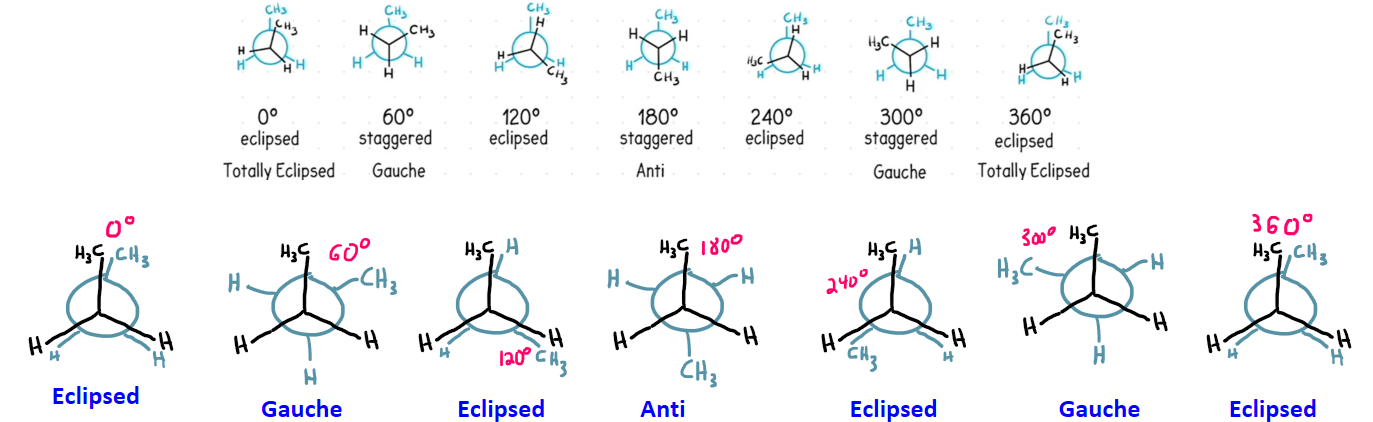
In the attached image, I've shown both the "front carbon" way and the "back carbon" way of rotating a molecule.  We can see that, starting from the totally eclipsed conformation of butane, viewed along the C2-C3 bond, each 60-degree rotation (of either carbon) gives the same relationship between the two methyl groups.

-Ben

2025-09-21-answer.png

Hi Kaya,

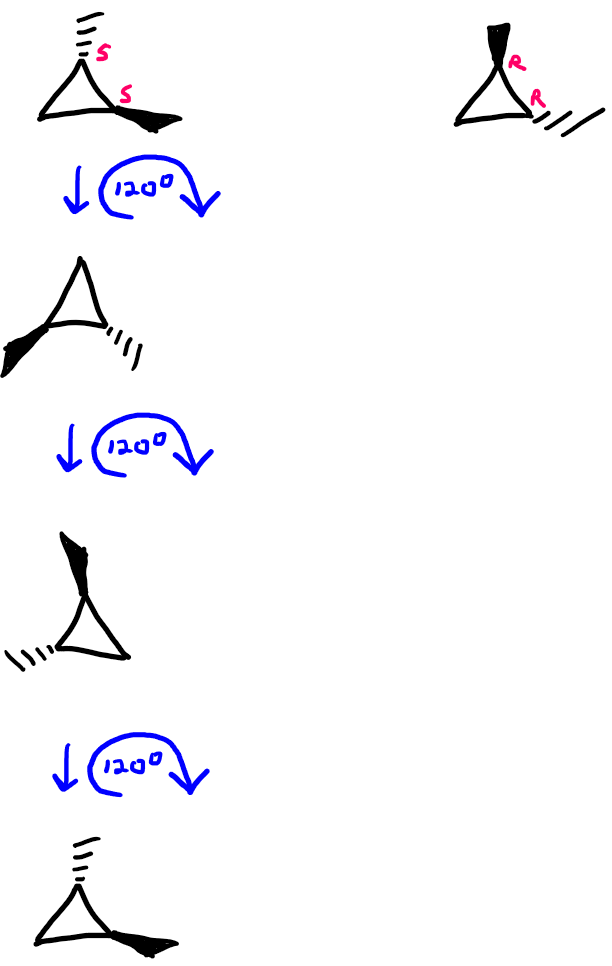
It may be difficult to visualize, but the molecules on the middle and right at that timestamp are not superimposable.  In the attached image, we see the effect of rotating the (S,S) isomer by a third of a turn multiple times.  No matter how many times we rotate it, we can't make it align perfectly with the other structure, the (R,R) isomer.

-Ben

19 Sep 16:53

Hi Diane,

Yes, it is possible that a primary carbocation is formed and then rearranges via 1,2 hydride shift to form a more stable tertiary carbocation.  However, since primary carbocations are so unstable, the energy barrier of accomplishing that first step (loss of the leaving group, formation of the 1° carbocation) is very high compared to the energy barrier of the SN2 pathway, in which you have nucleophilic attack on a carbon with little steric hindrance.  Therefore, it would occur to a negligible degree and the major product, by far, would be the product of SN2 substitution.

-Ben

19 Sep 16:39

Hi Edson,

Was there a particular example or part of the video that I can help clarify?  As long as the structures are drawn well and the connectivity and orientation of the atoms with respect to one another remain the same, then it's valid to draw a rotation around a single bond by shifting the substituents on either the front carbon or the back carbon.

-Ben

19 Sep 16:29

Hi Belle,

Yes, the signal would appear as a doublet because the carbon atom is bonded to one hydrogen.

In this case, since it's three carbons away from sub1 and there are no other carbons in the molecule that are also three carbons away from sub1, it has a unique signal in the spectrum.  Any carbon that has no chemical equivalence between itself and any other carbons in the molecule will get its own unique signal.

-Ben

Reply

19 Sep 16:15

Hi Belle,

The blue hydrogens have two neighboring hydrogens, yes, but those two neighboring hydrogens are chemically equivalent, so they count as one type of hydrogen.  Complex splitting occurs when there are two different types of neighboring protons.

-Ben

Reply