Ben - Subject Expert

Image for the badge Day One Done.
Day One Done earned for a 1-day streak!

Hi Esteban.

What starting material are you referring to here? Could you provide a timestamp related to your question?

-Ben

HI Samantha,

A nitrogen with four bonds would give a positive charge on the nitrogen atom, so a better way to represent it would be NHR2+.  Having four bonds also leaves the nitrogen without a lone pair.

So, NHR2+ can't donate electron density to the aromatic ring through resonance with a lone pair.  Not only that, but since the nitrogen is positively charged, it tends to withdraw electron density away from the aromatic ring, making the aromatic ring less nucleophilic, and therefore slower in electrophilic aromatic substitution reactions.

-Ben
2025-02-25-answer-v2.png

Hi Krystel,

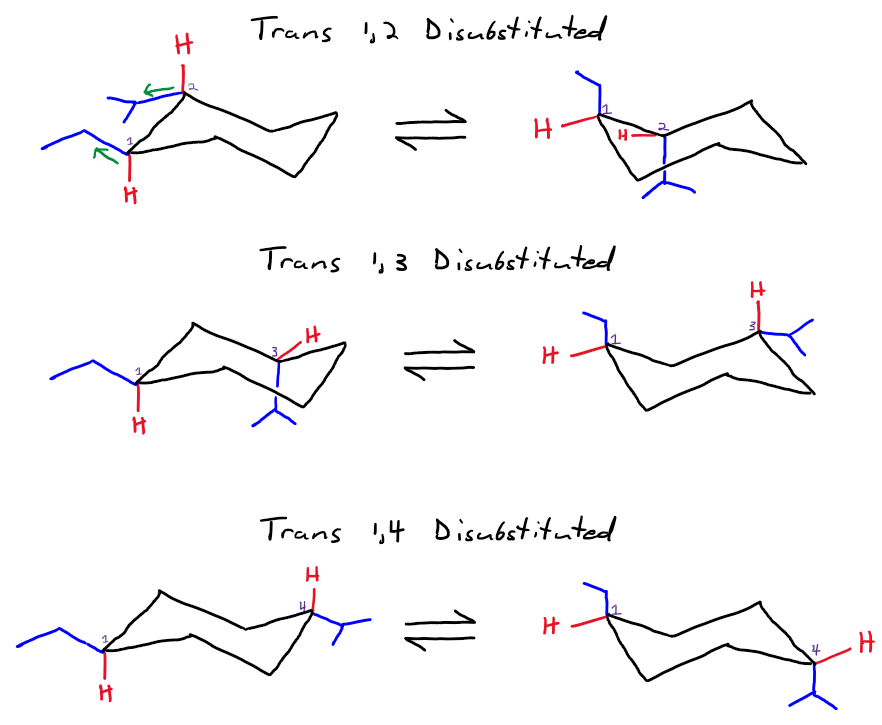
You're correct. Trans means the substituents are on opposite faces of the ring.

It may not be super obvious in the video, but in the conformer on the left, the ethyl group is pointed up in the equatorial position, and the isopropyl group is pointed down in the equatorial position.  For a trans 1,2 disubstituted cyclohexane, both substituents will be axial OR both substituents will be equatorial--never one of each.

Now, if you had a trans 1,3 disusbituted cyclohexane, then one substituent will be axial, and the other substituent will be equatorial--never both axial or both equatorial.

Another possibility is you have a trans 1,4 disubstituted cyclohexane, which follows the same pattern as a trans 1,2 disubstituted cyclohexane both substituents will be axial OR both substituents will be equatorial--never one of each.

All three of those examples--trans 1,2 ... trans 1,3 ... and trans 1,4 ... are summarized in the attached image.

-Ben

23 Feb 19:24

2025-02-23-answer.png

Hi Esteban,

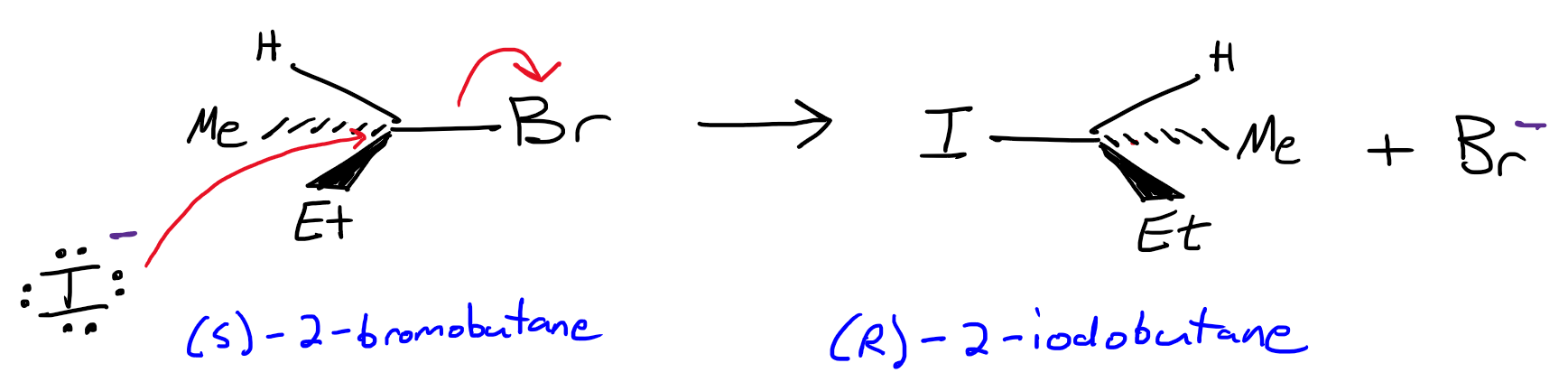
Just because the wedged substituent stays wedged and the dashed substituent stays dashed doesn't necessarily mean inversion of stereochemistry is not taking place.

For instance, consider the SN2 substitution of (S)-2-bromobutane by iodide ion in the attached image.  The methyl group remains wedged, and the ethyl group remains dashed.  However, the configuration of the chiral center has changed from S to R. 

What helps is to look at the chiral center of both the starting material and product, and determine whether it's R or S.  As Melissa says at 21:16, If we found the configuration of the chiral center in the starting material, it would be S, and if we did the same thing for the product, it would be R.

-Ben

Hi Pam,

Priority is given to atoms of higher atomic number.  In the case of carbon 2, it's bonded to a carbon atom and a hydrogen atom.  Since carbon has a higher atomic number than hydrogen, it takes priority.

-Ben

22 Feb 06:14

2025-02-22-answer.png

Hi Angelina,

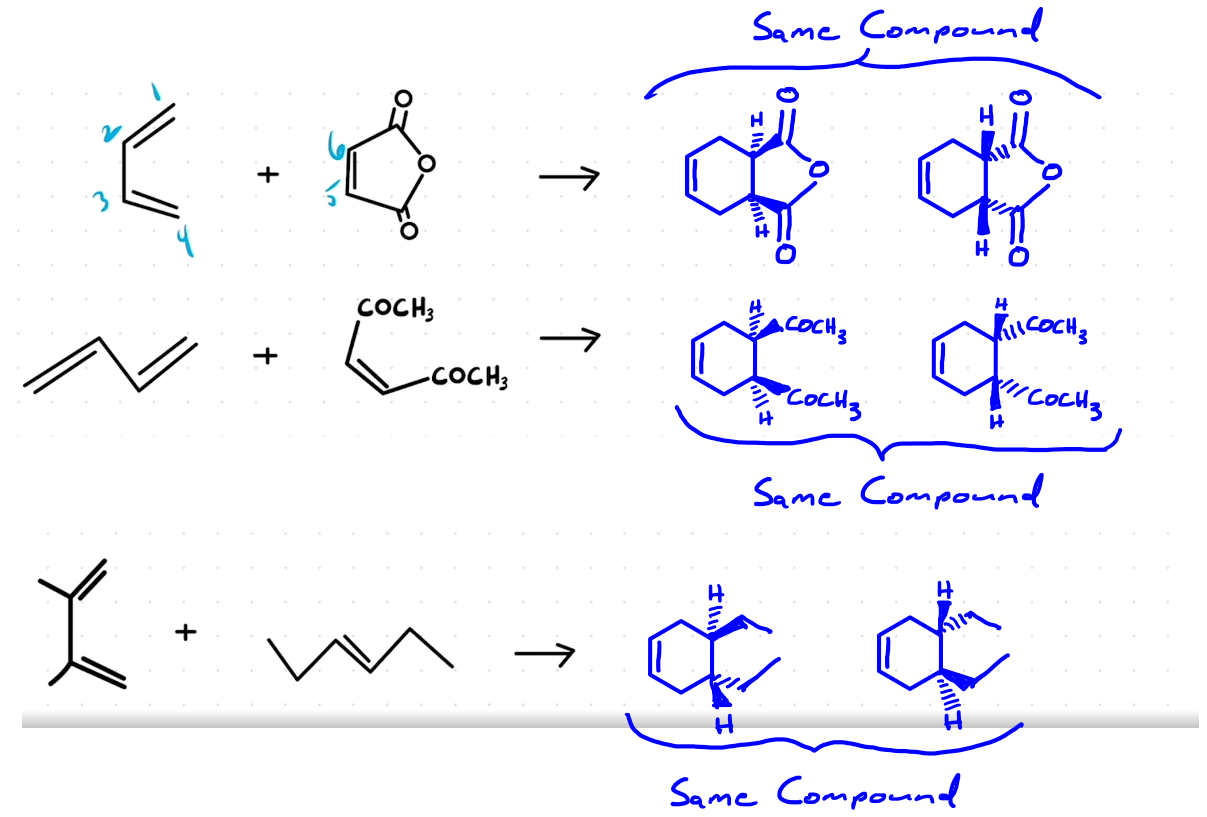
When the dienophile is cis, as in the first two examples, we draw its substituents on the same side of the ring in our Diels-Alder product, which means the they'll both be wedged OR they'll both be dashed.  It doesn't matter whether we choose wedged bonds or dashed bonds, as long as they're both pointing in the same direction.

When the dienophile is trans, as in the third example, we draw its substituents on opposite sides of the ring in our Diels-Alder product, which means that one of them will be wedged, and the other one will be dashed.  It doesn't matter which is which, as long as they're pointing in opposite directions.

-Ben

Hi Esteban,

Naming it "isopropoxymethane" would violate the second rule, which states that the R group with more carbons is the parent, and the R group with less carbons is a substituent.

However, the IUPAC also accepts a another way to name 2-methoxypropane.  Simple ethers with no other functional groups can be named by naming both organic substituents and adding the word ether.  So 2-methoxypropane can also be called isopropyl methyl ether.

The same alternative naming could be applied to the first example, ethoxycyclopropane, which could also be named cyclopropyl ethyl ether.

-Ben 

19 Feb 19:07

image5.png

Hi Kim,

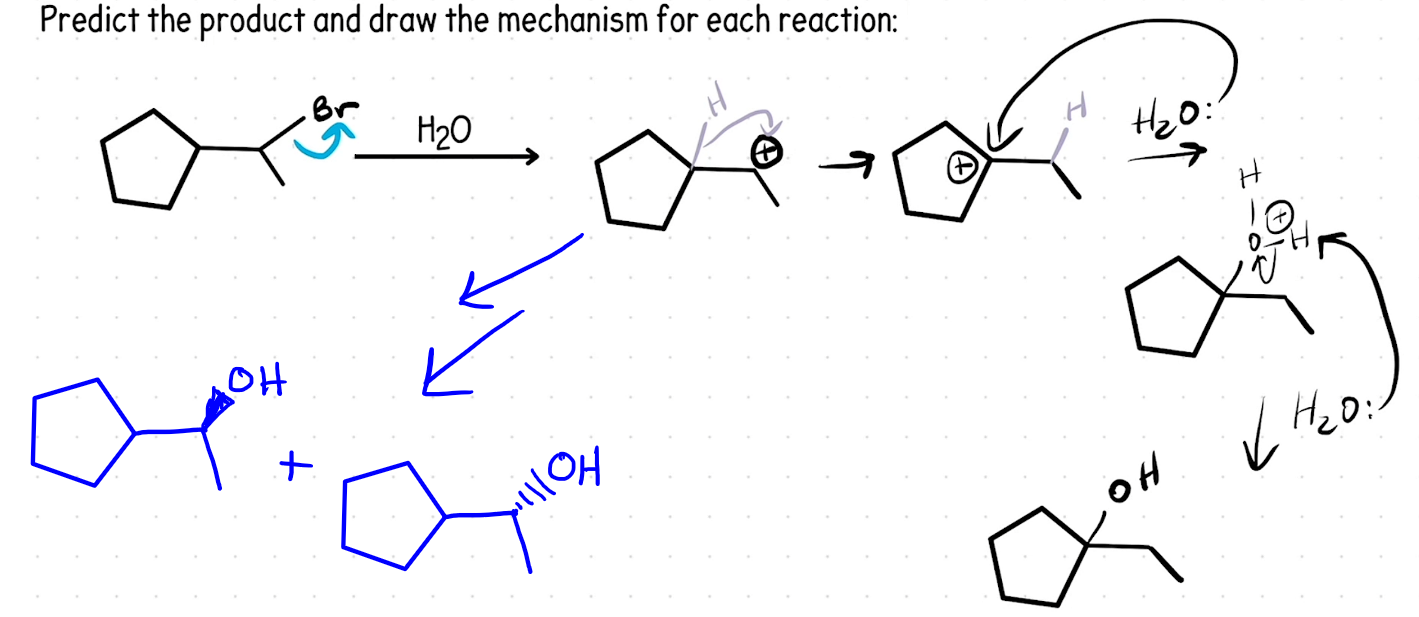
Apologies for the confusion; the problem should say "predict the major product and draw the mechanism".

You're correct.  The un-rearranged 2° carbocation will undergo substitution to some degree, albeit less than the rearranged 3° carbocation, giving a chiral substitution product.

-Ben

Reply

19 Feb 19:01

2025-02-19-answer.png

Hi Ava,

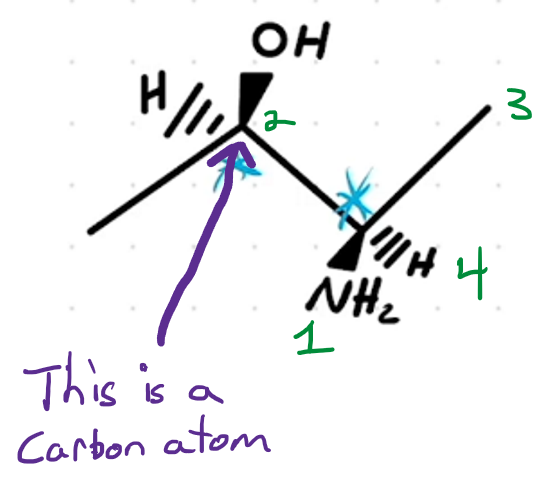
When assigning priorities, we first look at the atoms that are directly bonded to the chiral center.

In the case of the chiral center on the right, it is directly bonded to two carbons, a hydrogen, and a nitrogen.

Since nitrogen has a higher atomic number than the other three atoms, nitrogen takes first priority.  Since hydrogen has the lowest atomic number of the four, hydrogen is the lowest priority. 

For the two carbons, we look at the atoms bonded to them, and continue going down the chain until a difference is found.  The carbon on the left is bonded to an oxygen, a carbon, and a hydrogen.  The carbon on the right is bonded to three hydrogens.  Since the carbon on the left is bonded to higher-atomic-number atoms, it takes priority over the carbon on the right.  So the order is:

Nitrogen > left carbon > right carbon > hydrogen.

If the chiral center was bonded directly to a nitrogen and an oxygen, then yes, oxygen would take priority over nitrogen.

-Ben

2025-02-18-answer2.png

Hi Kostia,

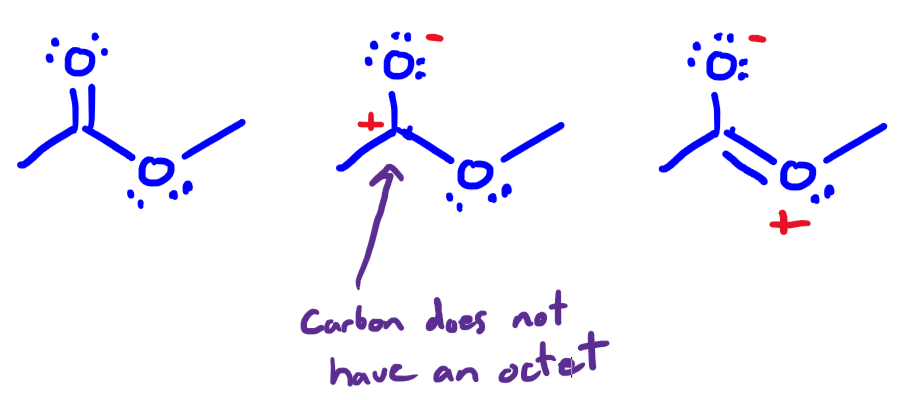
While neither of the two resonance forms shown would contribute significantly to the structure, the one with the carbon-oxygen double bond would contribute more significantly than the one in which carbon is positively charged.  This is because, in the carbon-oxygen double bond structure, all atoms have an octet, while in the "carbon is positively charged" structure, the carbon atom does not have an octet.

-Ben