Ben - Subject Expert

Image for the badge Day One Done.
Day One Done earned for a 1-day streak!
2025-03-20-answer1.png

Hi Helen,

See the attached image.  The direct way of preparing an amide from a carboxylic acid involves treating the acid with the amine to form a carboxylate salt which, upon heating, undergoes dehydration to yield the amide.

-Ben

Hi Juana,

The second example has two N's in the name because the nitrogen atom has two substituents bonded to it that aren't included in the parent name (two methyl groups).

The third example has only one N in the name because the nitrogen atom has only one substituent bonded to it that isn't included in the parent name (one isopropyl group).

-Ben
Hi Ethan,

The acid that is indicated by "H+" at the bottom of the reaction arrow isn't introduced until the final step of the mechanism.  Once the leaving group leaves, and we have the carboxylic acid and the amide ion, the reaction is still under basic conditions -- the carboxylic acid is the most acidic thing in the reaction mixture, so the amide ion can't be protonated by H+ at that point.  Once the amide ion is protonated by the carboxylic acid, acid is added to the reaction mixture, protonating the carboxylate ion to yield the product carboxylic acid.

-Ben

Hi Judith,

The author of the problem just chose not to include those two.

-Ben

10 Mar 04:53

Hi Helen,

Yes, the prefix tert- is ignored when assigning substituents in alphabetical order.  Another examples of a prefix that is treated this way is sec-.

For instance, a ketone with a sec-butyl group on one side and an ethyl group on the other side would be called sec-butyl ethyl ether, not ethyl sec-butyl ether, since we ignore the sec- and "B" comes before "E" in the alphabet.

To my knowledge, only sec- and tert- are treated this way.

-Ben

Reply
2025-03-09-answer-2.png

Hi Gloricel,

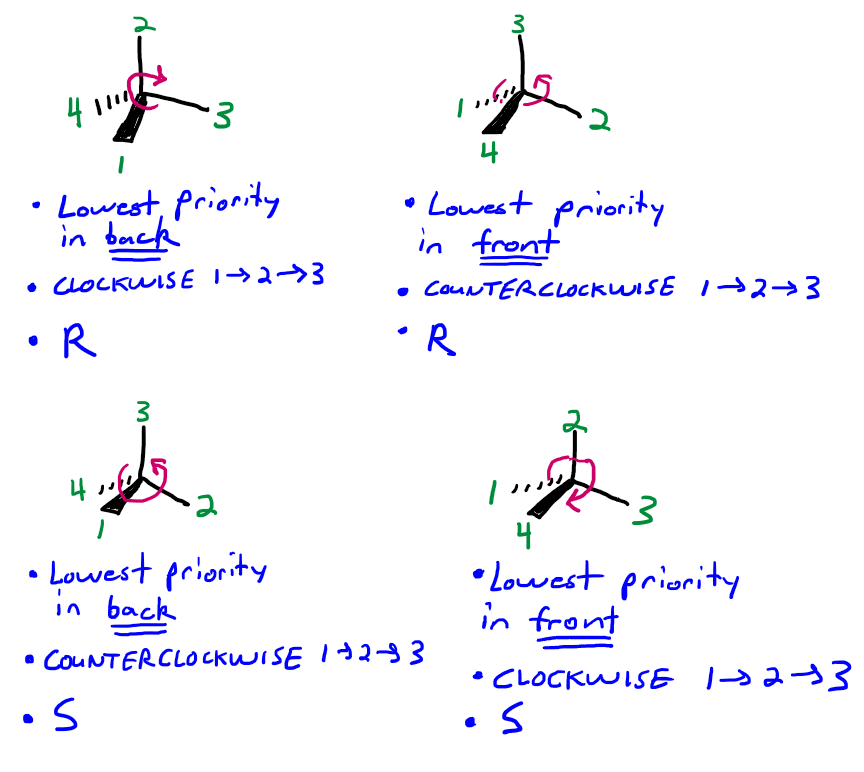
The R = clockwise, S = counterclockwise rule applies when the lowest priority group is in the back.

If the the lowest priority group is in the front, then it's reversed -- R = counterclockwise, S = clockwise.

The image I've attached sums it up.

-Ben 

2025-03-09-answer.png

Hi Nahiara,

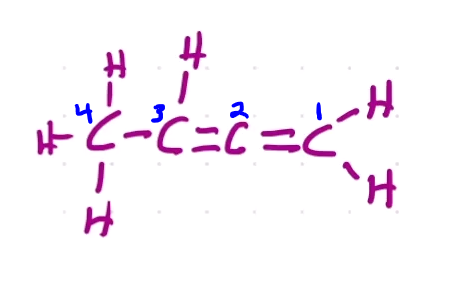
See the attached image.  Is this the one you're talking about?  It looks to me like each carbon has a total of four bonds.

Carbon 1 has one double bond and two single bonds, for a total of four bonds.

Carbon 2 has two double bonds, for a total of four bonds.

Carbon 3 has one double bond and two single bonds, for a total of four bonds.

Carbon 4 has four single bonds, for a total of four bonds.

-Ben

07 Mar 18:25

The lines inside the 3rd compound indicate the presence of double bonds.  Carbons that form double bonds with other atoms have unhybridized p orbitals.  A continuous chain (or in this case, a ring) of unhybridized p orbitals allows electrons to be delocalized (spread out) along the entire ring.  This spreading out of electron density leads to increased stability.

We can compare acid strength by comparing the stability of the acid's conjugate base.  In the case of Compound III, the negative charge of the conjugate base is spread out along the entire ring.  In Compound IV, this spreading out isn't possible because the carbon atoms don't have unhybridized p orbitals.

In other words, since the conjugate base of III is more stable than the conjugate base of IV, Compound III is more acidic than Compound IV.

-Ben

Reply

07 Mar 18:22

Hi Gustav,

For the first 2 compounds, we determine the hybridization of the carbon atom by finding the steric number, which is the number of sigma bonds and lone pairs.

If the steric number is 2, this corresponds to sp hybridization

If the steric number is 3, this corresponds to sp2 hybridization

If the steric number is 4, this corresponds to sp3 hybridization

In the case of compound I, the steric number is 2, so the carbon is sp hybridized.  This means that the bond between the carbon and the hydrogen is an overlap of carbon's sp hybrid orbital and hydrogen's s orbital.

Check the reply to this comment for the answer to your second question.

Reply
2025-03-02-answer.png

Hi Esteban.

The first mechanism shown at 02:28 is just a general mechanism meant to show the main ideas of nucleophilic acyl substitution--that is, the carbonyl carbon is attacked by a nucleophile, forming a tetrahedral intermediate, which re-forms the carbonyl and expels the leaving group in the next step.

To convert an ester into a carboxylic acid, yes, and acid or base catalyst required (see the summary slide at 03:05).

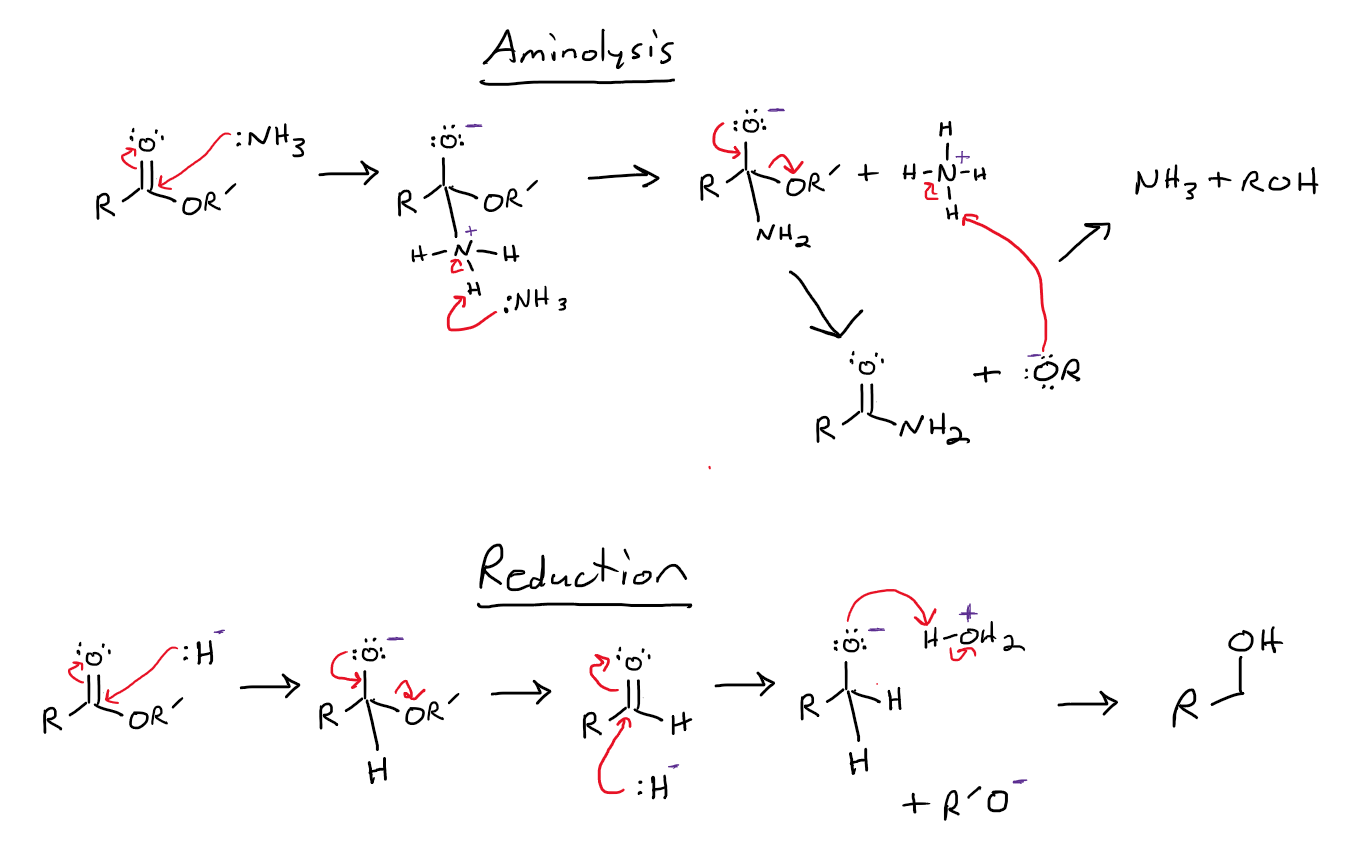
There are some reactions esters can undergo that don't require the use of an acid or base catalyst.  One of them is called aminolysis, in which an ester can react with ammonia (or a 1° amine) to yield an amide.  Ammonia is a base, but it functions as a nucleophile in the mechanism rather than deprotonating the leaving group.

Another reaction esters can undergo without an acid or base catalyst is reduction.  A hydride ion attacks the carbonyl carbon (without it being protonated or the leaving group deprotonated prior), ultimatedly yielding a 1° alcohol.

-Ben