screenshot-2024-04-18-1445132.png
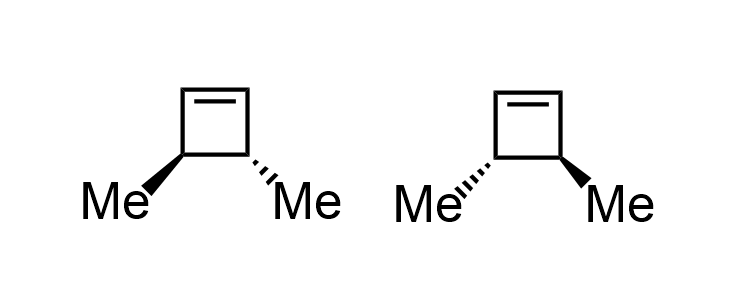
For the heat mediated cyclization at 46:15, you could also form the enantiomer of the compound drawn. Below are both of the possible products.

Replied on Lesson: Electrocyclic Reactions
For the heat mediated cyclization at 46:15, you could also form the enantiomer of the compound drawn. Below are both of the possible products.
Replied on Lesson: Wolff-Kishner Reduction
Replied on Lesson: Wolff-Kishner Reduction
Replied on Lesson: Wolff-Kishner Reduction
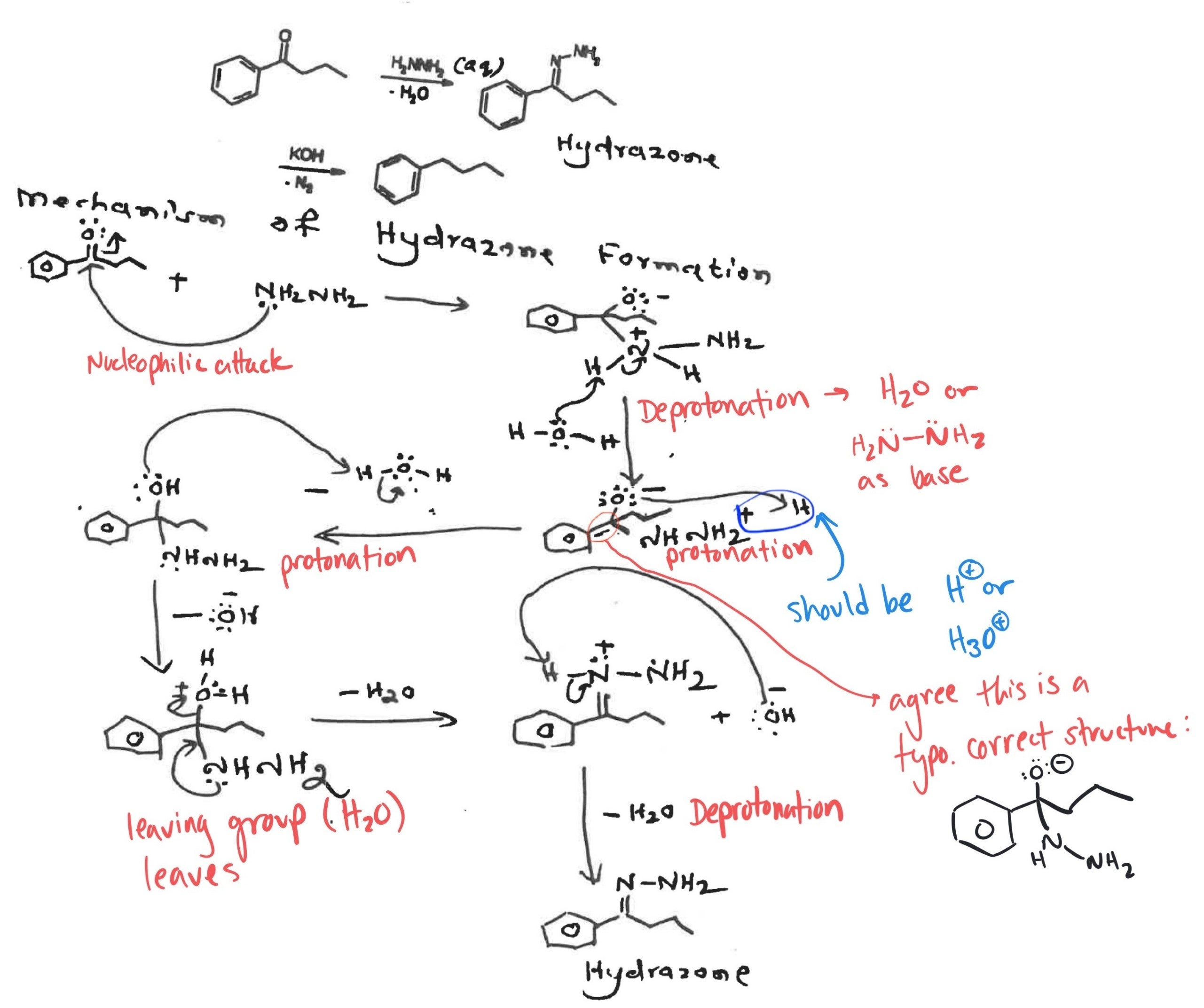
Hi Melanie, the main difference in these two mechanisms is that your professor uses water to do the deprotonation instead of another equivalent of hydrazine (3:14 above). Either can act as a base and remove a proton in this mechanism. I have added the name of each step of the mechanism so you can follow what Melissa is doing here on your Professor's notes.
Replied on Lesson: Naming Compounds With Chiral Centers
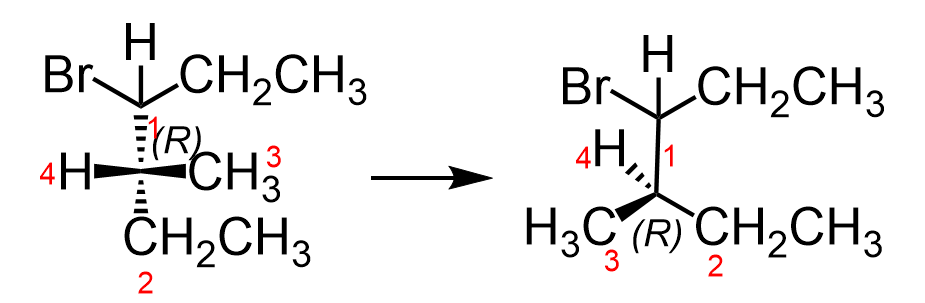
Carissa Granados, if we re-draw the molecule with H facing back, we would still get R stereochemistry. Ben is using a trick here to avoid having to re-draw the molecule. If the lowest-priority substituent is facing toward you, simply reverse the rule for R/S rotation:
If low-priority is 'away': If low-priority is 'towards':
Clockwise = R --------------------------->Clockwise = S
counterclockwise = S -------------------->Counterclockwise = R
Replied on Lesson: R and S Configurations
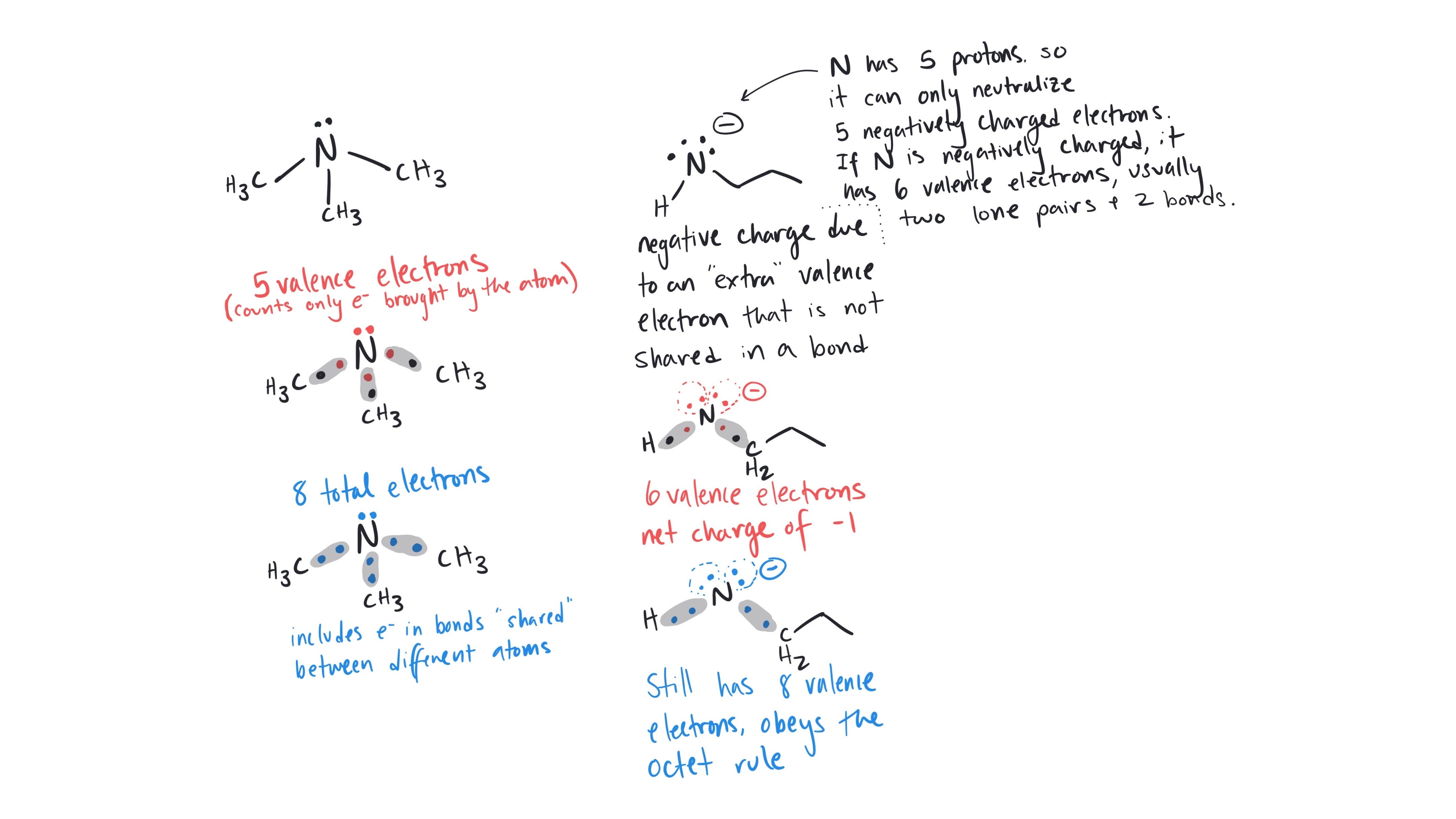
Ashley Wampler, great question! N does still have to obey the octet rule. However, it has a couple of choices on how it obeys the octet rule.
If it has 3 bonds and 1 lone pair, it can share more electrons in those three bonds. Effectively, this means the electrons (negatively charged) are spread out further from N, shared with the atoms next door. In this case, N will be neutral because its 5 protons (positively charged) can balance out the 5 electrons (negatively charged) that are closest to the nitrogen nucleus.
However, if N has a negative charge that means it can't balance all the negative charge from the electrons! In this case, there are 6 valence electrons and 5 N protons. This usually manifests as two lone pairs and two bonds (as at 9:15). N still obeys the octet rule, by sharing electrons in bonds, but more of the electrons are on N, giving it a negative charge.
Replied on Lesson: Reactions of Epoxides
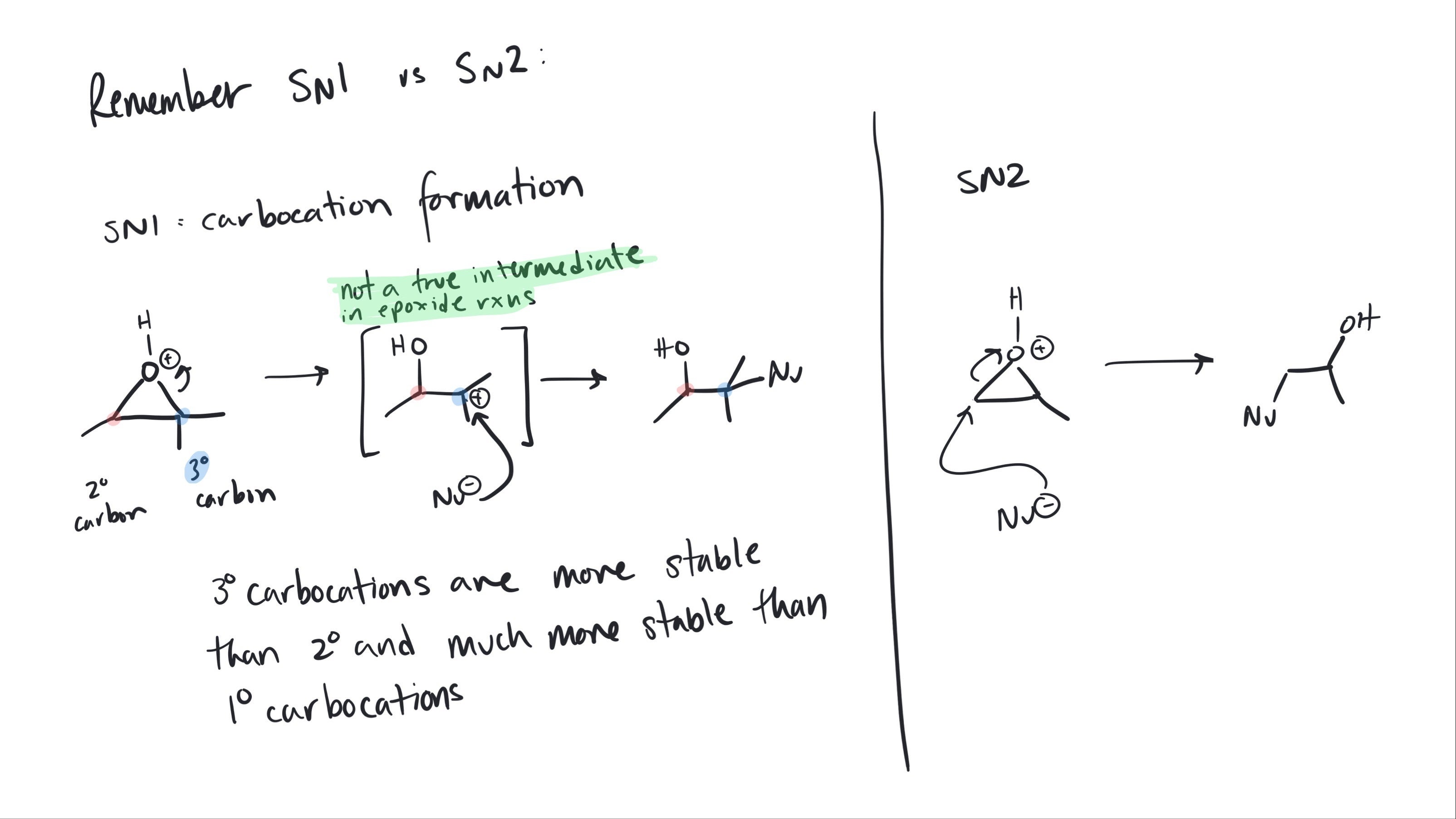
Hi Jag, great question! This gets to the heart of organic chemistry, where reactivity exists on a 'gradient' where more than one thing can happen. Melissa explains at ~17:00 why acid-promoted epoxide opening reactions can attack at the more substituted position.
The most important point is that tertiary carbons (having 3 non-hydrogen substituents) are the best at stabilizing positive charge. This is what we see in SN1 reactions, were tertiary carbocations are by far the most stable. While secondary carbons can form carbocations, they are not as good as tertiary carbons at stabilizing positive charge.
In this video, Melissa goes deeper than the general rules you have shown above to explain why reactivity at the more substituted position can happen. However, I recommend talking to your professor about their opinion and following their guidance as this is a 'grey area'.
Replied on Practice Problem: Which of the Following Is the Strongest Base?
29 May 17:09
Hi, the easiest way to determine hybridization is to count the number of groups bonded to the atom. Double and triple bonds count as one group.
1 group = s, 2 groups = sp, 3 groups = sp2, and 4 groups = sp3
https://chemmunity.com/programs/organic-chemistry-bond-length-strength-and-hybridization