Natalie - Subject Expert

em , D does not have a diastereomer because of its symmetry. We call this type of molecule 'meso' because you can draw a plane of symmetry through the molecule.

note-sep-23-2023.jpg

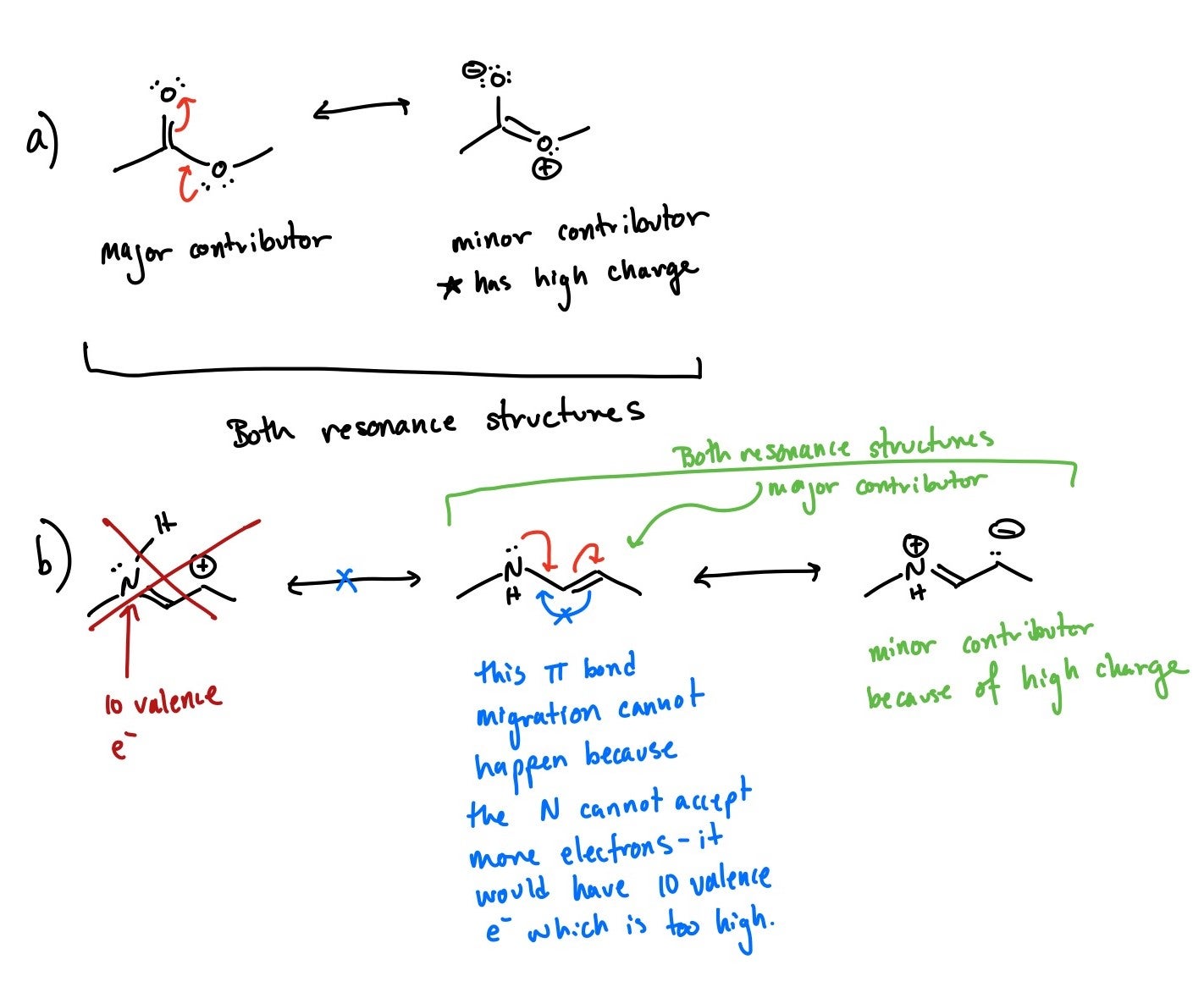
Saliho Toure, thanks for your questions. Remember the question that this video is covering is "what is the major resonance contributor". For A, the lone pairs on the oxygen can participate in resonance, but this resonance structure has a high formal charge, so it is not the major resonance contributor.

For B, there is another resonance structure that is not explicitly drawn in the video, again because it has high formal charge so it cannot be the major resonance form (contributor). If you are asked to draw all the resonance structures, it would be correct to draw the major and all minor resonance contributors.

Reply

Yes, that is correct!

Reply

21 Sep 07:13

Hi Hazel, oxygen act as as an electron donor, or a nucleophile, for a few reasons. First, oxygen usually has two lone pairs and readily forms pi bonds, so the valence electrons are quite accessible to react with another molecule. Second, because oxygen is electronegative it has a partial negative charge. You could think about this as a tiny magnet, which will attract molecules with positive charge (electrophiles). Third, remember that oxygen is less electronegative than atoms like fluorine which do not readily donate electrons. We can think of oxygen as a good middle ground- not too electronegative that it holds onto all its electrons, but more electronegative (and more reactive) than a more neutral atom like carbon. 

Reply
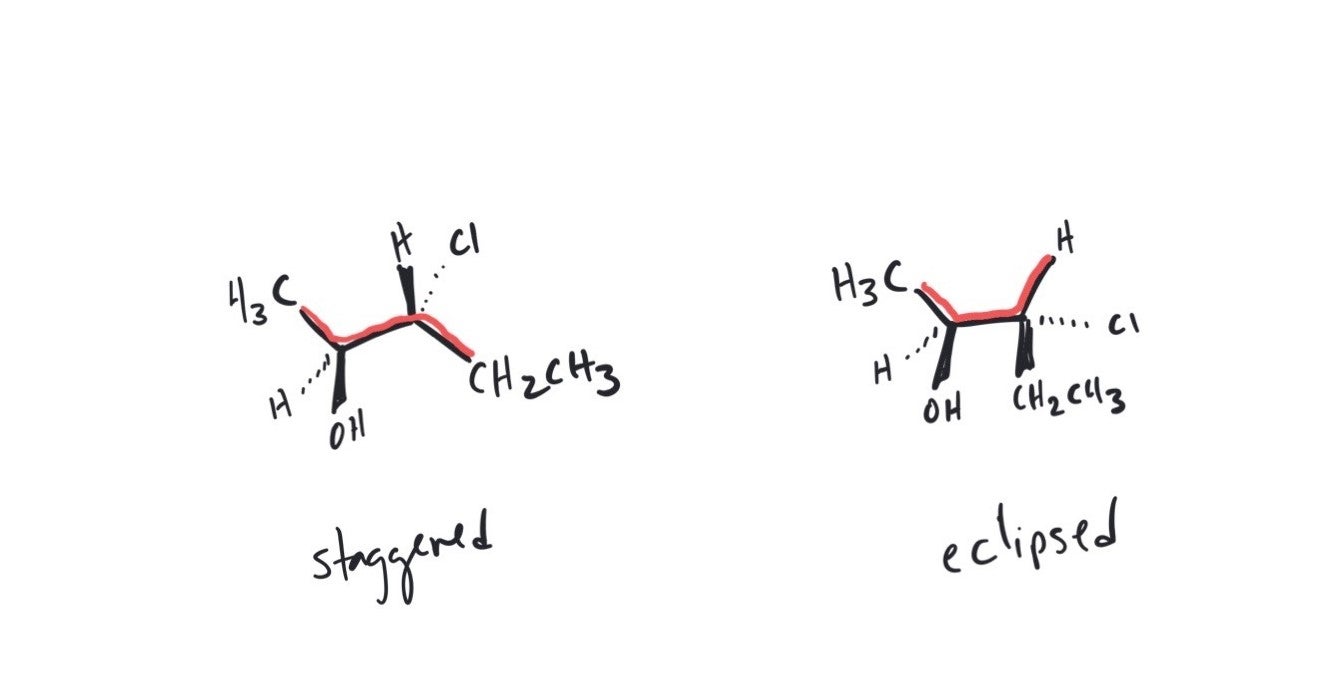
staggered-eclipsed.jpg

Hi Jessica, to determine if a complex is staggered or eclipsed, look at the solid lines which represent molecules in the same plane (the plane of the paper). If they are syn (on the same side) they will be eclipsed, if they are anti (180 degrees, on opposite sides ) they will be staggered.

Reply
capture.JPG

Hi Malone, thanks for following up!1) Exactly! Because the aromatic ring is highly symmetrical, it is not unusual to see a single signal. We can see some different splitting patterns in the peak around 7.2 ppm but they are not separated enough to determine splitting. This tells us that all the aromatic protons are similar!2) UPDATE: the degree of unsaturation is 5, we are aware of the error and updating the video accordingly.

If you know you have an aromatic ring, consider how you could make those protons chemically equivalent to match the number of signals you observe. In the first example, the single substituent had little effect on the protons, so the three signals we expected all overlapped to form one gigantic peak. In the second example, we have 4 aromatic protons and only two signals. This tells us that there are two groups of two H's which are chemically equivalent. This can be achieved with a para substitution pattern described at 12:28

r-s_2.jpg

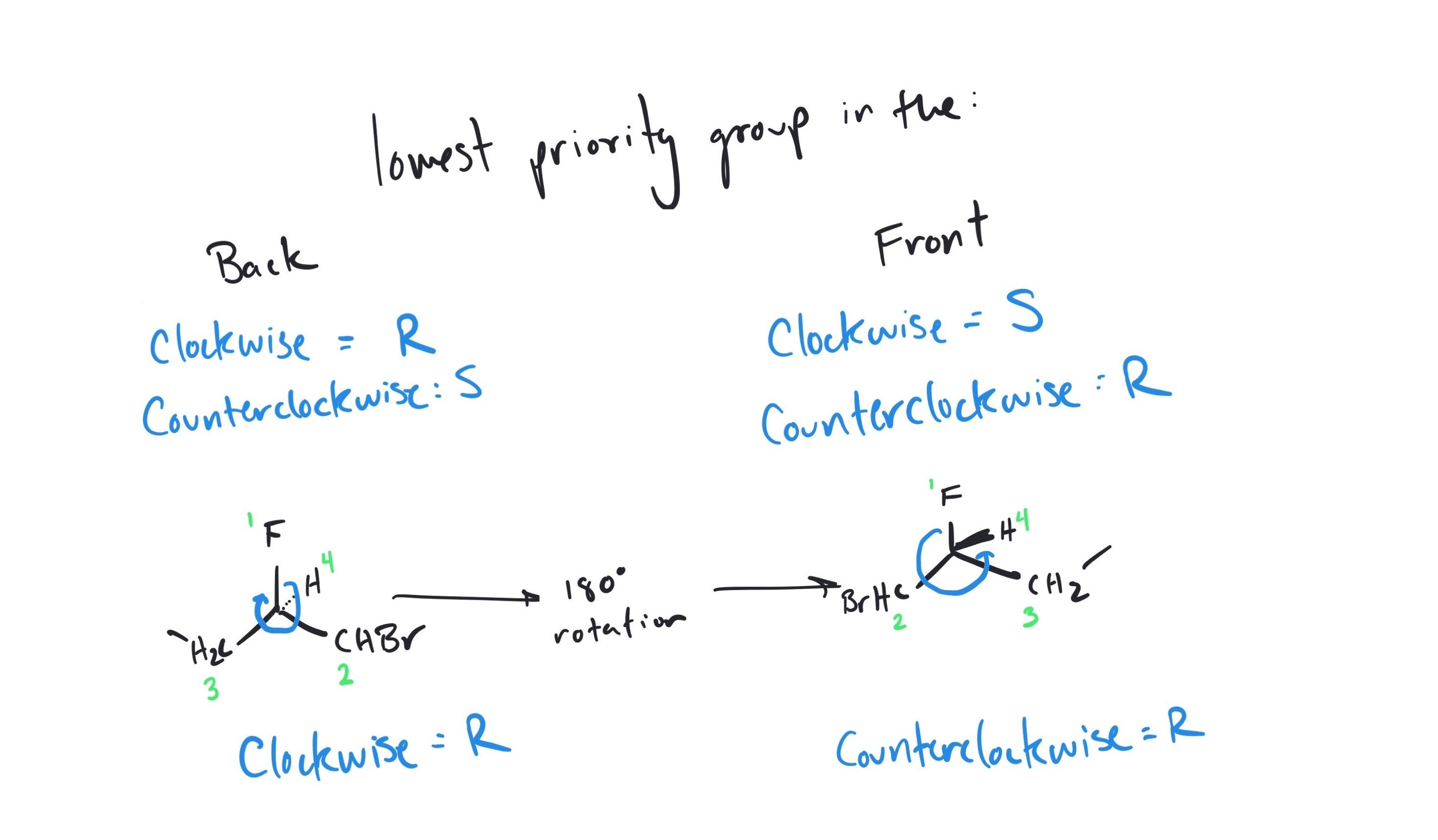
Hi Hussein, thanks for your question, the direction you 'look' absolutely matters! Get around this issue, the rule is to always have the lowest priority group (4 is this video) facing away from you when you determine clockwise or counterclockwise. If the lowest priority group is facing directly towards you, you can also use a handy trick described at (~3:00min) where you reverse the R/S designation. See the attached image for a cheat sheet!In the example of the ring, it can be tricky to imagine the orientation of all the substituents when you look at the molecule from different angles. I would recommend using a model kit to build each stereocenter, then turn the model so the lowest priority group is facing away from you. If you don't have access to a model kit, re-drawing the stereocenter as Ben has done (20:30) is a good way to isolate the groups of interest. Just be careful that you have translated everything correctly!

Reply