
Ben - Subject Expert

Image for the badge Day One Done.
Day One Done earned for a 1-day streak!
2025-04-06-answer2.png

Hi Belle,

The product of the reaction in the first problem doesn't have any chiral centers.  The two carbons that are part of the six-membered ring are equivalent, so there aren't four unique groups bonded to the 3° carbon.  Since it doesn't have four unique groups bonded to it, it's not a chiral center, so there's no enantiomer of this product.

-Ben

Reply
2025-04-06-answer.png

Hi Belle,

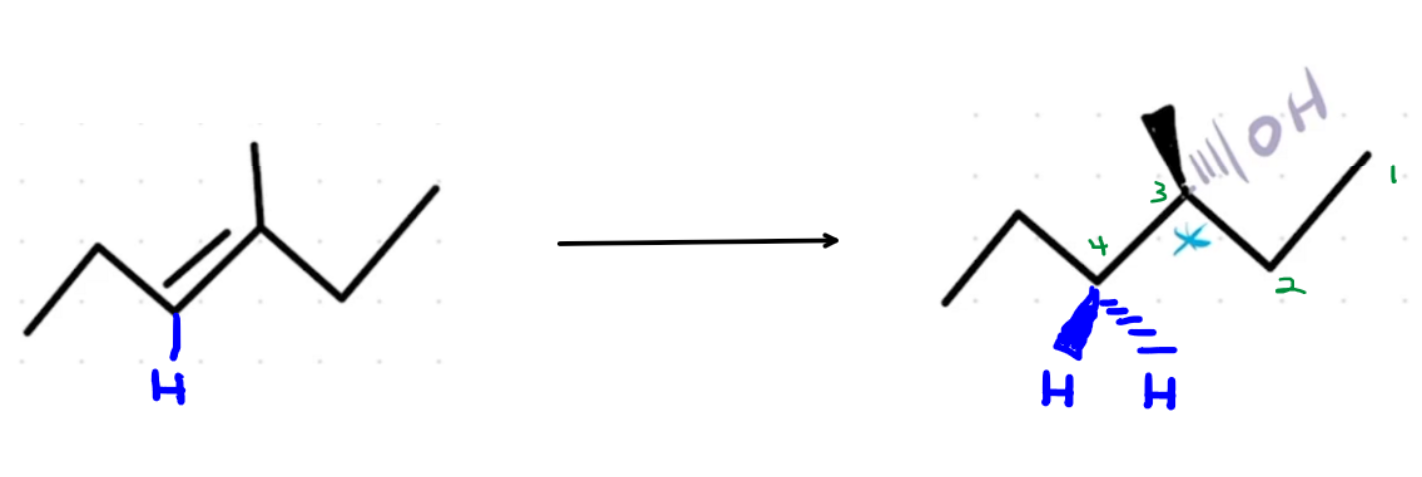
I don't see a halogen anywhere at that timestamp.  Do you mean the hydroxyl?

Generally, we use wedged and dashed lines to show the configuration of a chiral center (R or S).  If there's no chiral center, then we don't need to use wedged and dashed lines.

Carbon 4, where the hydrogen is added, already had a hydrogen before the reaction.  When the product forms, Carbon 4 is bonded to two hydrogens and two carbons.  Since it doesn't have four unique groups bonded to it, it's not a chiral center, so we don't need to use wedged and dashed lines to show stereochemistry.
Reply

Hi Mariana,

SN2 substitution does not occur because potassium tert-butoxide is a strong base, but a poor nucleophile.  The three methyl groups attached to the carbon atom bearing the oxygen atom are bulky and cause steric hindrance to SN2 behavior.

-Ben

Reply

06 Apr 18:47

Hi Abigail,

Yes, the 2° carbocation will react, to a lesser degree than the rearranged 3° carbocation, and a mixture of products would result.

-Ben

2025-04-03-answer.png

Hi Edelyn,

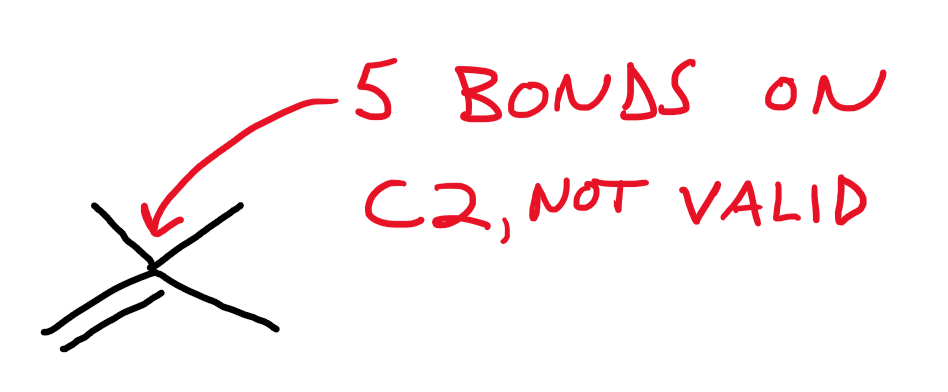
If we had a three-carbon chain with a pi bond between Carbons 1 and 2, putting two methyl groups on Carbon 2 would mean that Carbon 2 has 5 bonds, which would not be a valid Lewis structure.

Do I understand your question correctly?

-Ben

27 Mar 20:14

2025-03-27-answer.png

Hi Riya,

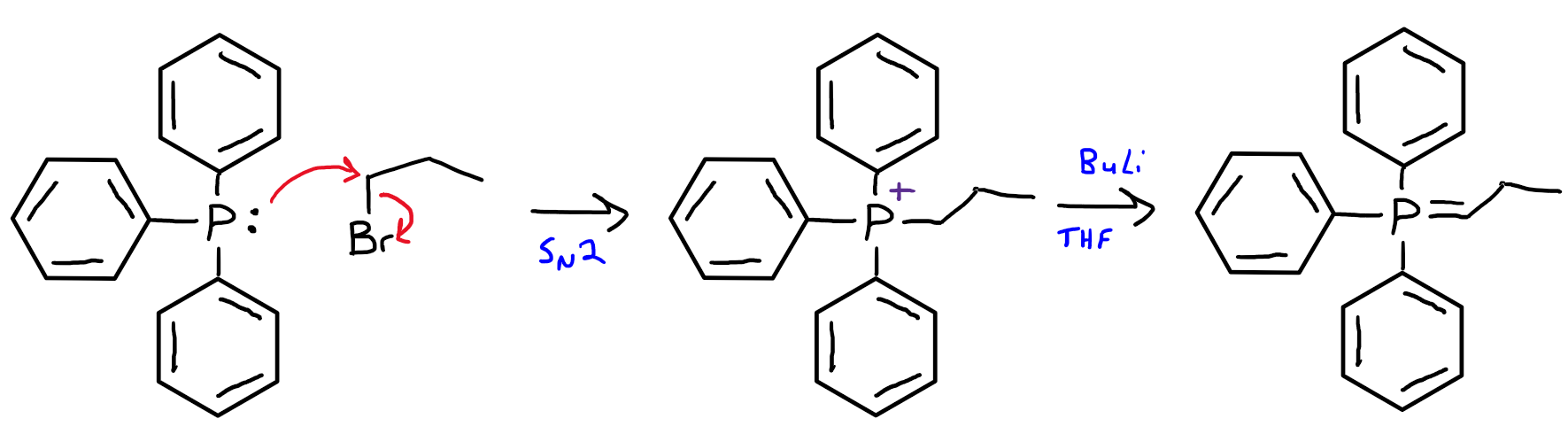
Yes, that would be incorrect.  In order to make the PPh3=R, it must be prepared from PPh3 and RX.  The mechanism for the preparation of a phosphorus ylide from an alkyl halide is shown in the attached image.  Once prepared, the ylide reacts with the ketone to form the product.

The BuLi reagent is not used to convert the ketone to the product.  Rather, it's used to convert the alkyl halide to the phosphorus ylide.

-Ben

Hi Esteban,

Cholesterol is a steroid. It has the same fused ring structure of three six-membered rings and one five-membered ring as the hormones discussed in this video.

-Ben

23 Mar 06:32

Hi Esteban,

No, functional group priority is not based on reactivity.  For instance, alcohols are more reactive than ketones, but ketones take priority over alcohols for naming purposes.  A molecule containing both a ketone and and alcohol would end in "one", not "ol".

Functional group priorities have been ranked based on an arbitrary agreement among the IUPAC. The link below lists them.

https://www.acdlabs.com/iupac/nomenclature/93/r93_326.htm

-Ben

Hi Esteban,

They were.  It wasn't shown because the task given by the problem was to predict the products, not to show the entire mechanism. The net effect of the reaction is the replacement of the nitrogen with an oxygen (giving the ketone), and the addition of a -H to the CH3CH2N portion, giving ethylamine.

If the task was to show the mechanism, then yes, you'd have to show protonation of the imine in the first step.

-Ben

Hi Helen,

The conversion of a carboxylic acid to an acid chloride, followed by conversion to an ester is probably the most common way to prepare esters in the laboratory.  However, not ALL esters can be easily prepared this way.

The reaction of the acid chloride with the alcohol is strongly affected by steric hindrance.  Bulky groups on either the acid chloride or the alcohol can slow down the reaction significantly.

-Ben