Natalie - Subject Expert

Hi Mona, thanks for your question. Electrophilic aromatic substitution (EAS) and nucleophilic aromatic substitution (NAS or SNAr) have different mechanisms, and therefore different trends when it comes to reactivity.

If you are asked to rank the reactivity of substituted benzene molecules, look at the other reagents for clues. Remember that EAS needs to have a strong electrophile (a group that receives electrons, or gets attacked, sometimes these are positively charged).  In EAS, you are correct, moleucles with electron donating groups (EDG) are the most reactive.

For NAS or SNAr reactions, the other reagents must have a strong nucleophile (a group that donates electrons or attacks another molecule, sometimes these are negatively charged or have lone pairs of electrons). In SNAr, electron withdrawing groups (EWG) are the most reactive because they make the ring a better electrophile.

Reply

14 Jan 14:44

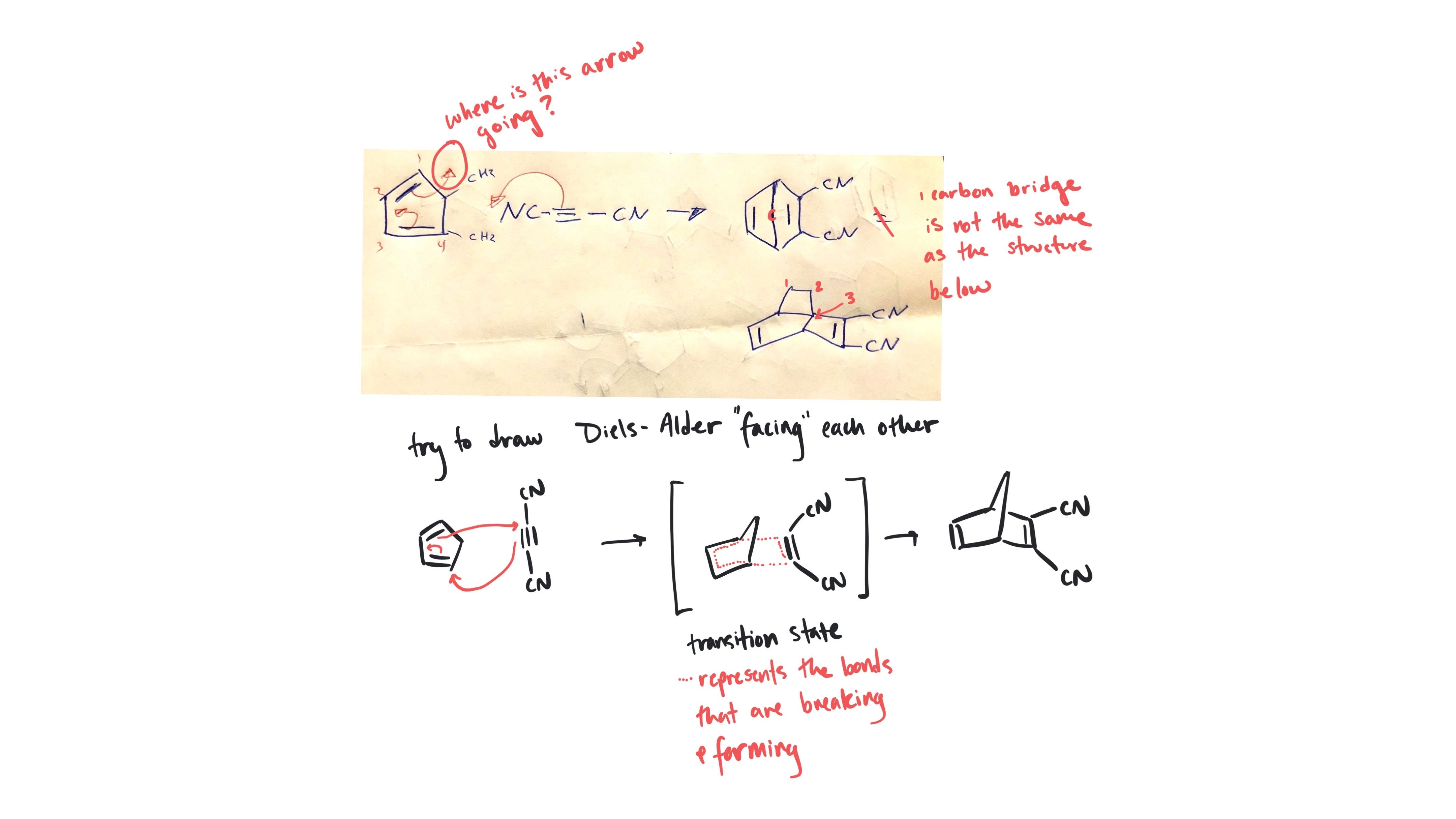
Mariam, I see. You have drawn a completely different starting material, the cyclic and open-chain are not the same molecule and can't interconvert. Your arrows look correct for the starting material you have drawn, but see my notes below on the correct product.

Reply

13 Jan 09:27

whiteboard-63.jpg

Hi Mariam, if you mean "locked" in terms of endo vs exo, because our coupling partner is an alkyne, there will not be any stereochemistry at the CN functional groups. We will form a 2,2,1-bicycle, be careful to count your carbons! The lowest drawing you have here has 2 extra carbons in the bridge!

Reply

Joselyn Lavado, the structure would have to have 2 double bonds to have the correct number of C and H atoms.

Mariam, it's always better to provide more information in the name of a compound. However, since most alkenes in a cyclic structure are Z (the E geometry makes closing the ring very challenging!), it has become customary to name the ring a cyclo-xxx-ene. For example Z-cyclohex-1-ene and cyclohexene could be the same molecule, but in the first name we have the alkene geometry and position (double bond starting at carbon 1).

whiteboard-51.jpg

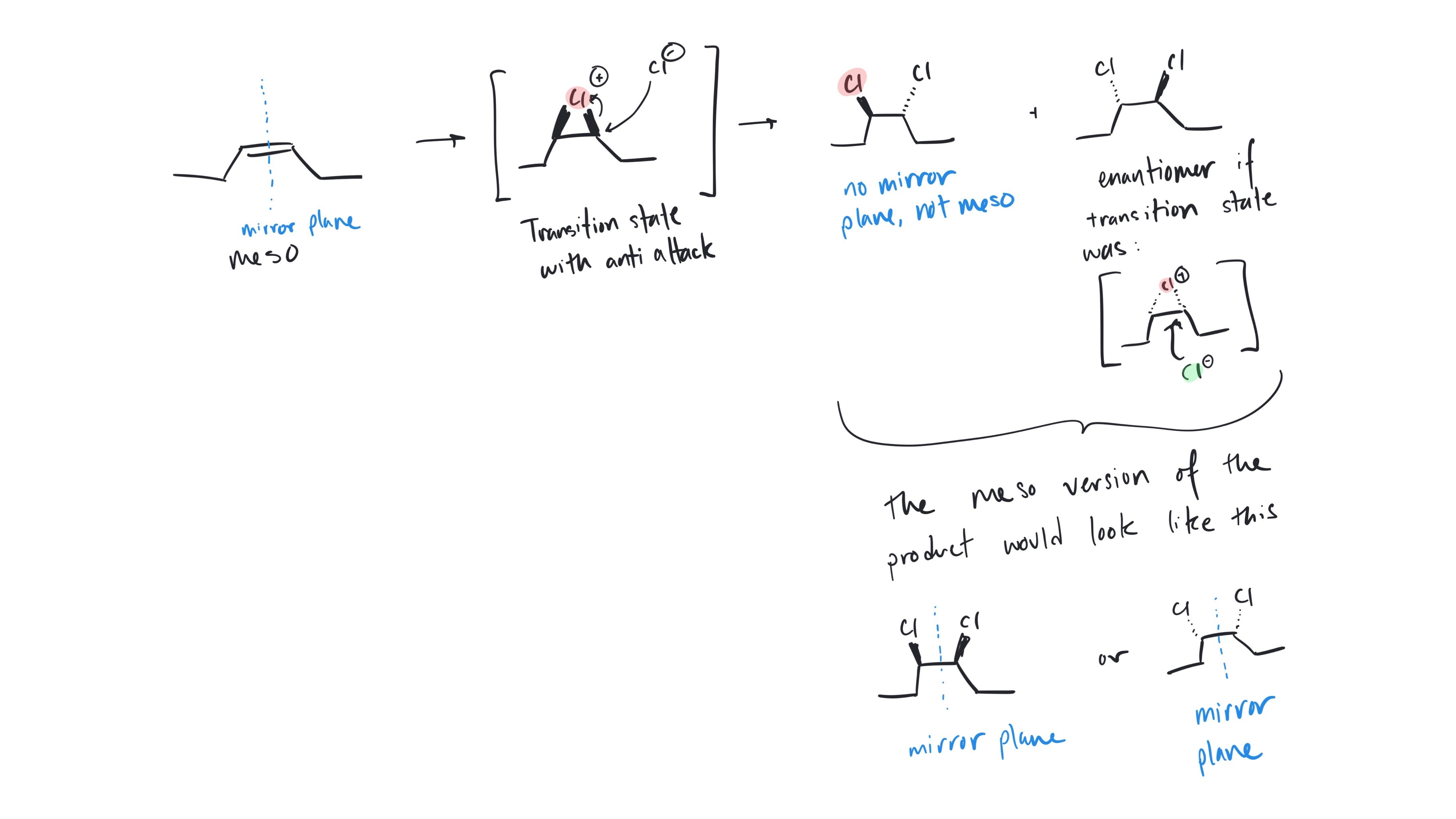
Hi Aliyah, compound 2 has rotational symmetry, but is not meso. Remember you can identify meso compounds by imagining holding up a mirror to the molecule. If they other half is reflected in the mirror, the compound is meso! More info attached in the image below

Reply

Hi Victoria, oxirene is a tricky one because the heteroatom contributes 2 electrons to the pi system. Take a look at the logic at 13:55 with azirine, which only has 1 lone pair. Oxygen will have 2 lone pairs, and one set of these will be aligned with the pi system (conjugated). Oxirene will be antiaromatic because it has 4 pi electrons: 2 from the double bond and 2 from an oxygen lone pair. 

Hi Damian, when the double bond is contained within a ring (like in questions B and C), we must assume the alkene is cis (Z, depending on the priority of the other substituents), to complete the ring geometry. For example, we name the ring cyclohexene (for C).

note-nov-5-2023.jpg

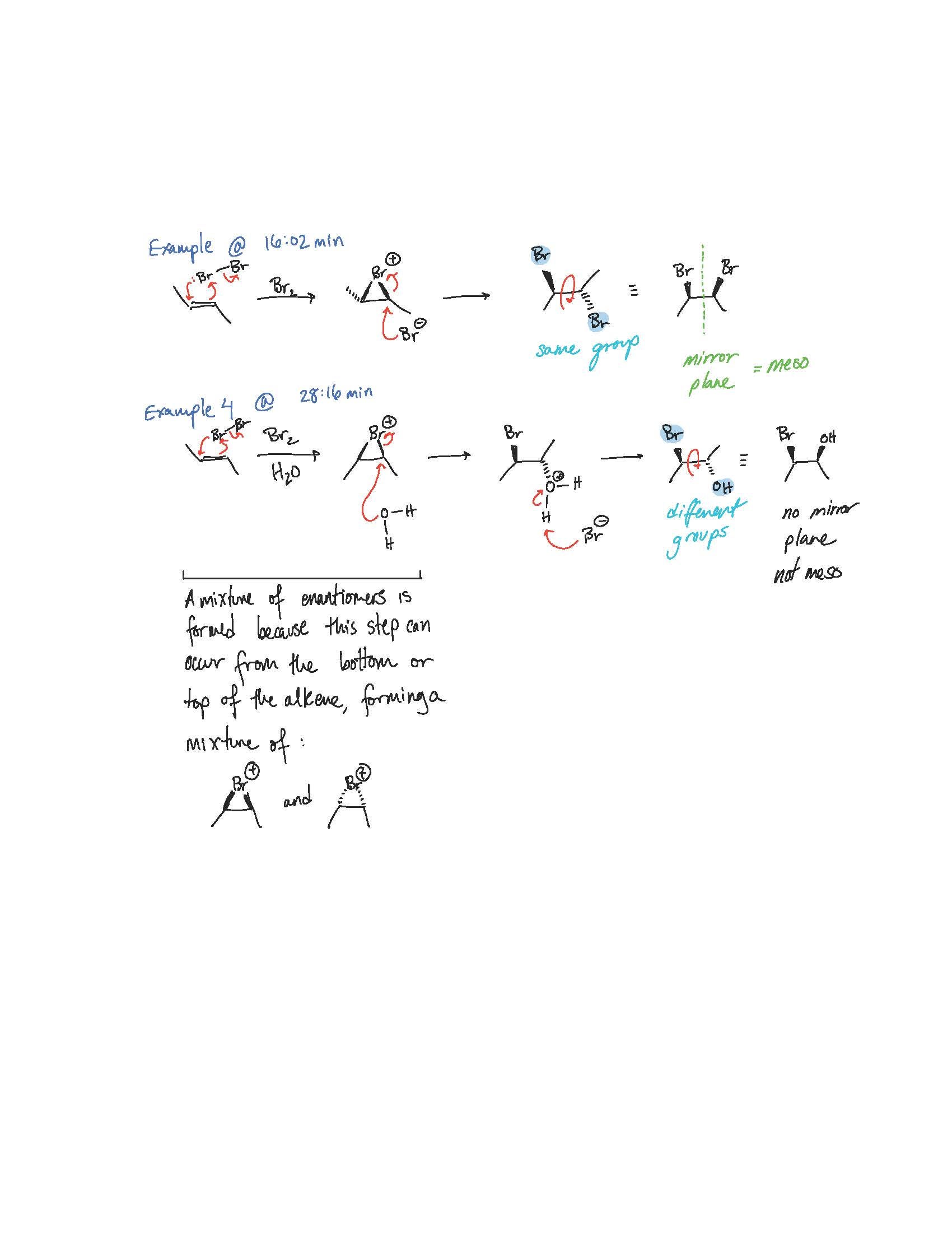
Yosra Abdallatif, I think the confusion might come from the image above getting cut off a little. The lower group in this example at 28:13 is not Br, but OH coming from the hydroxy group.

Yosra Abdallatif, remember meso compounds have a 'mirror' plane of symmetry. These molecules are not superimposable if you placed a mirror down on the piece of paper.